
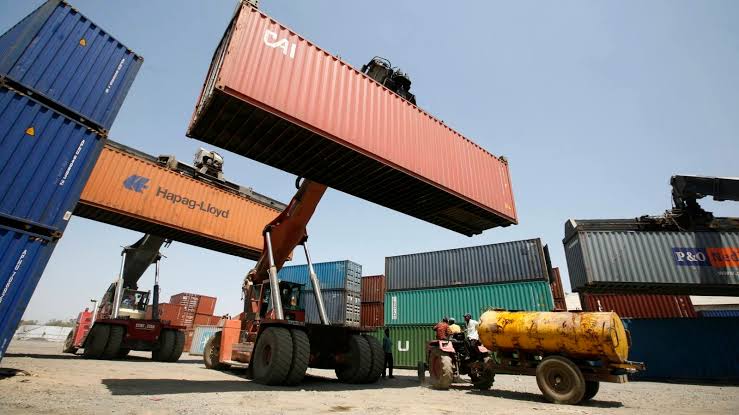
Food exports drive Pakistan’s record $11.37 bn export earnings
KARACHI (Staff Report): Food exports have emerged as the primary driver of Pakistan’s record export performance, helping push the country’s total export earnings to an unprecedented $11.374 billion during the first four months of FY2026-27, according to Topline Securities.
The latest figures released by the Pakistan Bureau of Statistics (PBS) show that exports increased by 8.8 percent year-on-year from $10.448 billion recorded during July-October FY2025-26, adding approximately $926 million to the country’s export receipts.
While the record performance offers a positive indication for Pakistan’s external sector, the growing contribution of food shipments also raises questions about the breadth and sustainability of export growth.
According to Topline Securities, based on first-quarter FY2026-27 trends, the increase in exports was primarily driven by higher food exports. However, the available figures do not establish the precise contribution of individual food commodities or their share in the overall increase.
The development comes as Pakistan continues to seek stronger export diversification and greater foreign exchange earnings to support its balance of payments.
Historical data indicate that Pakistan’s exports have followed a fluctuating trajectory over recent years. Export earnings stood at approximately $7.06 billion during the first four months of FY2017-18 before gradually increasing towards the $9.6 billion range during the corresponding periods of FY2021-22, FY2022-23 and FY2023-24.
The country subsequently recorded a stronger performance in FY2024-25, when exports reached approximately $10.89 billion during the July-October period. However, earnings slipped to $10.448 billion in FY2025-26 before recovering to the latest record of $11.374 billion.
The increase reflects an improvement in export receipts, although maintaining this momentum throughout the remaining months of the fiscal year will be crucial.
Higher export earnings can support foreign exchange inflows, ease pressure on the external account and help reduce dependence on external financing. Nevertheless, the long-term impact will depend on whether Pakistan can sustain growth across a wider range of export-oriented industries.
The food sector’s contribution highlights the importance of agricultural productivity, processing capacity and access to international markets. Greater value addition could also help Pakistan generate higher earnings from its existing agricultural production.
For policymakers, the challenge is now to translate the record performance into a sustained expansion of the export base rather than relying on a limited number of growth drivers.
Although crossing the $11 billion mark in four months represents a significant milestone, the real test will be whether Pakistan can maintain export growth through improved competitiveness, diversification and higher-value products.
The latest performance provides encouraging momentum, but sustaining it will require broader participation from the country’s manufacturing, agricultural and industrial sectors.