
PSX faces trust deficit: Senate questions barriers to investor growth
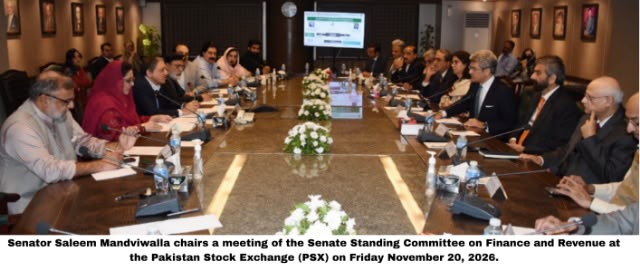
KARACHI (News Desk): Pakistan’s ambition to develop a deeper and more vibrant capital market faces significant structural challenges, including public distrust of stock market investments, regulatory barriers to new listings and limited participation by individual investors. These concerns came under discussion during a visit by the Senate Standing Committee on Finance and Revenue to the Pakistan Stock Exchange (PSX), where lawmakers examined investor protection, market transparency, taxation policies and measures to broaden participation.
Chairman of the committee Senator Saleem Mandviwalla, accompanied by other members, reviewed the performance and operational framework of the country’s capital market and questioned whether existing policies were sufficiently supporting investor confidence and private-sector access to equity financing.
One of the most significant concerns raised during the meeting was the public’s lack of confidence in the stock market. A senator observed that distrust of the PSX had created fear and reluctance among potential investors, preventing them from participating in a market that could otherwise provide opportunities for wealth creation and support economic growth.
The discussion highlighted concerns surrounding misleading corporate disclosures, market manipulation and misconduct by listed companies. A joint presentation by the PSX and Securities and Exchange Commission of Pakistan (SECP) outlined existing investor protection mechanisms and safeguards designed to strengthen market transparency.
Senator Mandviwalla also discussed measures that the exchange needed to adopt to improve investor safety and facilitate sustainable market growth. The broader concern was that a stock market cannot expand its investor base simply through rising share prices and trading activity; it must establish credibility among households and businesses that remain reluctant to invest.
PSX representatives acknowledged the need to increase the depth of the investor pool, identifying financial literacy and public awareness as important components of the strategy. The exchange outlined plans to engage universities and educational institutions to familiarize younger generations, particularly millennials and Gen Z, with stock market operations and investment opportunities.
However, expanding financial literacy will require parallel improvements in transparency, corporate governance and investor protection. Public awareness campaigns may introduce new investors to the market, but sustained participation will depend on whether they feel adequately protected against malpractice and misleading information.
Another important issue concerned the accessibility of the capital market for private-sector companies seeking to raise funds through initial public offerings (IPOs). Senators questioned whether excessive regulatory requirements and compliance restrictions were discouraging new businesses from becoming publicly listed companies.
The discussion focused on the gap between the requirements applicable to private limited companies and those imposed on businesses seeking admission to the stock exchange. Lawmakers questioned what additional support and regulatory facilitation would be necessary to encourage more companies to enter the capital market.
The issue carries wider economic implications for Pakistan, where businesses remain heavily dependent on conventional bank financing and internal resources. A more accessible IPO framework could provide companies with alternative sources of capital, enable business expansion and offer investors opportunities to participate in corporate growth.
PSX representatives maintained that greater accessibility could not come at the expense of regulatory safeguards, stressing the importance of maintaining checks and balances while facilitating new entrants. The committee encouraged the exchange to submit recommendations for tax incentives and other government support that could help strengthen the market and attract greater participation.
The scale of the existing capital market infrastructure provides a foundation for further expansion. The briefing covered more than 200 brokers and 25 asset management companies, including five fully fledged Islamic asset management companies, collectively managing approximately $17 billion in assets under management. The presentation also indicated that equity assets accounted for around 13 percent of the reported assets under management.
The committee was also briefed on the ownership structure of the market, with figures presented indicating a 40 percent shareholding by a Chinese consortium, 50 percent held by domestic investors across 40 companies and the remaining 10 percent by other foreign investors.
During the visit, PSX officials demonstrated the exchange’s live trading mechanism, explaining how buyers and sellers interact through brokers and submit competing bids and offers. The system processes transactions within milliseconds and provides information on previous closing prices and current market movements. Officials also explained Market by Order and Market by Volume mechanisms used to organize trading information.
Beyond capital market reforms, the committee discussed broader financial and fiscal issues. These included government expenditure rationalisation, with initiatives reportedly aimed at achieving annual savings of approximately Rs120 billion, and measures to address foreign exchange outflows estimated at $300–400 million through domestic card transactions.
Unconsenting bank SMS alert charges also came under scrutiny, reflecting the committee’s broader interest in consumer protection and transparency in financial services.
The senators further emphasized the importance of involving the private sector at an early stage of the federal budget-making process. The possibility of institutional collaboration with business think tanks was also discussed to improve consultation and strengthen fiscal policy formulation.
The meeting brought together representatives of the PSX, SECP, Central Depository Company, National Clearing Company of Pakistan and the Taxpayer Office, including the chief commissioner of FBR Karachi.
Ultimately, the discussions exposed a wider challenge for Pakistan’s economic policy. Developing a competitive capital market requires more than improving index performance or increasing trading volumes. It demands public trust, effective investor safeguards, a business-friendly listing framework and greater participation from domestic savings and emerging enterprises.
For Pakistan, the real test will be whether these discussions translate into practical reforms that bring more investors into the market and enable more businesses to raise capital through public listings. Without addressing these structural constraints, the country’s stock market risks remaining an important financial institution whose potential to support broader economic growth remains underutilized.
In the past brokers have quietly sold the shares of the investors, pocketed the money and are absconding. None of the government organisations like PSX, SECP, CDC, NCCPL, did anything to catch the culprits and return the money to their rightful owners . This is the sole reason why nobody trusts the stock exchange and do not invest in it.
Unless the government catches these culprits, extracts the money from them and return it back to the rightful owners, no investor is going to invest his money in the stock exchange