
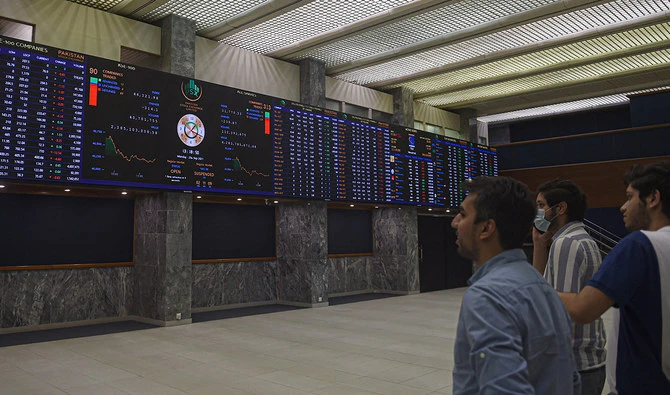
PSX Weekly: KSE-100 falls 491 points as trading value drops 37%
KARACHI (Staff Report): The Pakistan Stock Exchange (PSX) ended the outgoing business week in negative territory as investors opted to book profits following recent gains, with a sharp decline in trading activity reflecting cautious participation despite the benchmark KSE-100 Index remaining above 177,000 points.
The benchmark index shed 491 points, declining 0.28% week-on-week to close at 177,383 points. During the week, the index touched an intraday high of 179,693 points and a low of 176,054 points, highlighting considerable fluctuations in market sentiment.
The decline came despite improving economic indicators, including a current account surplus in October, higher foreign direct investment and growth in technology exports. However, these developments were insufficient to prevent investors from taking profits, particularly after the market’s recent upward movement.
A more pronounced development was the decline in trading activity. Average daily trading volume fell 21% week-on-week to 853.3 million shares, while average daily traded value dropped 37% to $89 million.
The sharper decline in traded value compared with volume suggests that market participation weakened in monetary terms, although the figures alone do not establish whether investors were withdrawing capital or simply reducing their exposure.
Market capitalization of the KSE All-Share Index declined by Rs75.5 billion during the week to Rs19.26 trillion, representing a weekly decrease of approximately 0.4%.
Sector performance remained divided
A sector-wise assessment showed that investment banks and fertiliser companies provided the strongest support to the benchmark index, partially offsetting losses in banking, cement, exploration and production, and technology stocks.
Investment banks emerged as the largest positive contributors, adding 662 points to the KSE-100 Index. Fertiliser companies contributed another 239 points, while the power sector added 175 points.
Engineering and leather and tanneries also made smaller positive contributions of 23 and 18 points, respectively.
On the negative side, the banking sector emerged as the biggest drag, subtracting 334 points from the benchmark index. Cement companies reduced the index by 281 points, followed by exploration and production companies with 214 points.
Technology stocks contributed to a further decline of 203 points, while automobile assemblers removed 175 points.
The contrasting sector performance indicated that buying interest remained concentrated in selected stocks rather than being broadly distributed across the market.
At the individual stock level, ENGROH was the leading positive contributor, adding 642 points to the index. EFERT contributed 266 points, while HUBC added 197 points. BAHL and FFC contributed 74 and 62 points, respectively.
Among the major negative contributors, LUCK reduced the index by 222 points, followed by MEBL with 142 points, SYS with 139 points, PSEL with 134 points and HBL with 126 points.
Trading concentrated in selected stocks
Trading activity remained concentrated in relatively low-priced and actively traded securities.
WTL led the volume table with average daily trading of 155.4 million shares, followed by PASL with 61.3 million shares and CNERGY with 29.6 million shares. FNEL and TISL recorded average daily volumes of 28 million and 25.8 million shares, respectively.
Among KSE-100 constituents, PGLC emerged as the biggest gainer, rising 61%, followed by MEHT with a 7.6% increase. ENGROH gained 7.1%, EFERT rose 5.9%, while INIL advanced 5%.
On the losing side, YOUW declined 12.5%, followed by AICL with a 10.8% fall. PSEL lost 8.8%, GAL declined 6.3%, while GHNI shed 5.9%.
Economic indicators present a mixed picture
Developments in the broader economy offered some positive signals during the reporting period.
Pakistan recorded a current account surplus of $39 million in October 2026, compared with a deficit of $307 million in October last year and $371 million in September 2026.
For the first four months of FY27, the cumulative current account deficit narrowed to $850 million from $1.062 billion in the corresponding period of the previous fiscal year.
Foreign direct investment also recorded growth, increasing 22% to $936 million during July-October FY27 against $764 million in the same period last year.
Meanwhile, technology exports rose 17% to $453 million in October, while cumulative technology exports during the first four months of FY27 increased 18% to $1.899 billion.
These developments indicate improvements in selected external-sector indicators, although their impact on equity-market sentiment may depend on their sustainability and the broader economic outlook.
The decline in the benchmark index despite these developments also highlights the distinction between improvements in macroeconomic indicators and short-term stock-market movements.
For the week, the market’s performance was shaped more immediately by profit-taking, sector-specific selling and reduced trading activity.
With the KSE-100 closing at 177,383 points, investor attention is likely to remain focused on corporate earnings, economic indicators and developments affecting interest rates, exchange-rate stability and foreign investment flows.