
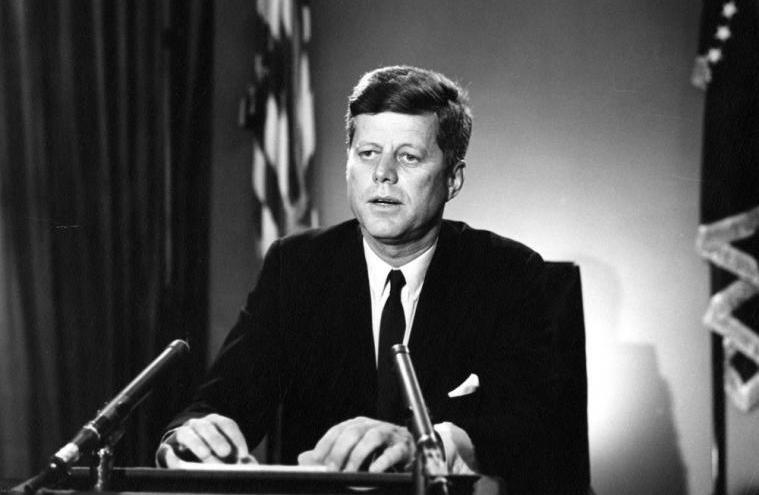
JFK, the Federal Reserve & silver-certificate mystery
More than six decades after his assassination, John F. Kennedy remains at the centre of a monetary controversy involving an executive order, America’s currency system and the enduring question of who controls the power to create money.
KARACHI (TKP Feature): On June 4, 1963, US President John F. Kennedy signed a document that would acquire a remarkable afterlife in American political history. Executive Order 11110 was a relatively technical measure concerning the issuance of silver certificates, yet decades later it became the foundation of one of the most persistent conspiracy theories surrounding his assassination.
According to the theory, Kennedy was attempting to challenge the Federal Reserve by returning control of American currency issuance to the US Treasury. Some proponents go further, suggesting that his assassination in Dallas on November 22, 1963, was connected to this alleged confrontation with powerful financial interests.
The narrative is intriguing, particularly because Kennedy signed the order less than six months before his death. But the historical record tells a considerably different story.
There is no credible evidence that Kennedy intended to abolish the Federal Reserve or that his monetary policies motivated his assassination. Nevertheless, the controversy opens a much larger discussion about monetary sovereignty, central-bank independence and the relationship between political authority and financial power.
The institution at the centre of the controversy
Established in 1913, the Federal Reserve System became the central banking institution of the United States, responsible for conducting monetary policy, influencing interest rates, supervising financial institutions and supporting financial stability.
Its structure is distinctive. The Board of Governors is a federal government agency, while the regional Federal Reserve Banks operate within a system combining public responsibilities with a particular corporate structure.
The Federal Reserve also enjoys considerable operational independence from the executive branch. Its monetary policy decisions are not supposed to be dictated by the president’s immediate political priorities.
This independence reflects an important economic principle: monetary policy often requires decisions that may be unpopular in the short term but necessary for longer-term stability.
For example, raising interest rates to control inflation can increase borrowing costs and slow economic activity. Politicians seeking economic growth may prefer cheaper credit, while central bankers may consider tighter monetary conditions necessary to protect purchasing power.
This tension between political priorities and monetary discipline remains relevant to economies across the world.
Why silver became a problem for Washington
To understand Kennedy’s executive order, it is necessary to revisit the American monetary system of the early 1960s.
Silver certificates were paper currency issued by the US Treasury and backed by silver held in government reserves. They had circulated in the United States for decades and represented an important link between the country’s currency and precious metals.
However, rising industrial demand and increasing silver prices were putting pressure on the government’s silver reserves. Maintaining the existing system was becoming increasingly difficult.
Kennedy addressed the issue before signing Executive Order 11110.
In a letter dated November 28, 1961, he outlined his administration’s intention to reduce the monetary role of silver and gradually withdraw it from monetary reserves. He also supported legislation allowing Federal Reserve Banks to issue one-dollar and two-dollar notes as replacements for corresponding silver certificates.
This is an important historical detail because it contradicts the claim that Kennedy was preparing to replace Federal Reserve currency with a new Treasury-controlled monetary system.
His administration was actually facilitating a transition towards greater use of Federal Reserve notes.
What Executive Order 11110 actually did
Signed on June 4, 1963, Executive Order 11110 amended an earlier executive order governing the delegation of presidential functions to the Secretary of the Treasury.
It delegated specified authority concerning silver certificates, including their issuance against eligible silver holdings, as well as certain powers relating to silver coinage.
The order did not create a new currency, establish an independent Treasury monetary system or give Kennedy unlimited authority to print money.
It was an administrative measure dealing with existing presidential powers over silver-related currency arrangements.
The same day, Kennedy signed Public Law 88-36, which repealed several earlier silver-related laws and amended the Federal Reserve Act to authorise the issuance of one-dollar and two-dollar Federal Reserve notes.
Together, these measures formed part of a broader transition away from silver-backed certificates.
The distinction is crucial. The executive order did not dismantle the Federal Reserve. The accompanying legislation actually expanded the authorised denominations of Federal Reserve notes.
How a technical monetary decision became a conspiracy theory
The conspiracy narrative developed around the apparent symbolism of Kennedy’s action.
Its proponents argue that the Treasury’s authority to issue silver certificates represented a challenge to the Federal Reserve’s control over American money. They then connect this alleged conflict to Kennedy’s assassination five months later.
Some versions claim that Kennedy intended to introduce billions of dollars in government-issued currency and that these notes were withdrawn following his death.
However, silver certificates had existed long before Kennedy became president. Their issuance was not a new monetary initiative designed to undermine the Federal Reserve.
Furthermore, the historical direction of Kennedy’s monetary policy was towards replacing silver certificates with Federal Reserve notes, not establishing an alternative currency system.
The conspiracy theory also overlooks the distinction between currency issuance and monetary policy. Modern money creation involves a complex interaction between central banks, commercial banks, government finances and financial markets. The existence of Treasury-issued certificates does not mean the Treasury independently controlled the entire monetary system.
There is no credible documentary evidence establishing that Kennedy intended to eliminate the Federal Reserve or that the institution had a role in his assassination.
The assassination and the search for hidden motives
Kennedy’s assassination in Dallas on November 22, 1963, remains one of the defining events of modern American history.
The Warren Commission concluded in 1964 that Lee Harvey Oswald acted alone. However, the House Select Committee on Assassinations reached a different conclusion in 1979, finding that Kennedy was probably assassinated as a result of a conspiracy.
The committee could not identify the other gunman or establish the full extent of the alleged conspiracy. Its investigation did not establish any connection between the Federal Reserve, Executive Order 11110 and Kennedy’s death.
Nevertheless, the assassination created an environment in which competing explanations flourished. Kennedy’s disagreements over foreign policy, intelligence matters, Cuba and the Cold War became subjects of continuing historical debate.
The Federal Reserve theory became another part of this wider search for hidden motives.
Its appeal is understandable. It connects a mysterious political assassination with an institution that exercises enormous influence over the world’s largest economy. But the apparent connection is not supported by documentary evidence.
Historical uncertainty should not be confused with proof of a particular conspiracy.
Why the debate still matters
Beyond the controversy, the Kennedy-Federal Reserve story raises a question that remains relevant to modern economies: who should control the power of money?
Central banks influence borrowing costs, investment decisions, inflation, employment and financial stability. Their decisions can affect businesses, governments and households alike.
At the same time, governments remain responsible for fiscal policy, taxation, public expenditure and national economic priorities. The relationship between these institutions is therefore central to economic governance.
For developing economies, the question is particularly significant. Countries facing inflation, currency depreciation and external financing pressures frequently experience tension between political demands for cheaper credit and the need for monetary discipline.
Pakistan offers a contemporary example. The State Bank of Pakistan operates under a statutory framework that assigns it responsibility for monetary policy and price stability. Its interest-rate decisions influence business financing, investment and household borrowing.
The wider lesson is that monetary sovereignty is not simply about who prints banknotes. It concerns the institutions, laws and economic mechanisms through which money is issued, circulated and managed.
Kennedy’s executive order did not overthrow America’s central banking system. Its historical significance lies in the changing relationship between silver, government currency and the Federal Reserve.
More than six decades after his death, the controversy surrounding Executive Order 11110 continues to demonstrate how complicated monetary policy can become entangled with political mythology.
Perhaps the most enduring question is not whether Kennedy attempted to dismantle the Federal Reserve, but why control over money remains such a powerful subject of public fascination.
In the end, the historical record offers a clearer answer than the conspiracy theories: Kennedy helped oversee America’s transition away from silver-backed currency, while the Federal Reserve remained firmly in place.
Editorial note: The article deliberately avoids presenting an unsubstantiated assassination theory as historical fact.