
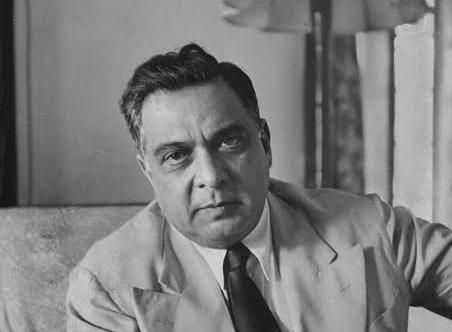
Iskander Mirza: The President who opened Pakistan’s door to Martial Law
KARACHI (TKP Feature): Pakistan’s political history has few figures as complicated as Major General Iskander Ali Mirza, the country’s first president, whose political journey began in the corridors of the British Indian administration and ended in exile in London. Born on November 13, 1899, and dying on the same date in 1969, Mirza remains a significant figure in understanding the constitutional and political developments that shaped Pakistan during its formative years.
On his birth and death anniversary, his legacy deserves a balanced examination. Remembered particularly for imposing Pakistan’s first martial law in 1958, Mirza was also an experienced military officer, administrator and senior government official who occupied several important positions during the country’s early years. His presidency reflected both the challenges of building a new state and the consequences of political decisions that weakened its constitutional institutions.
From military service to the highest office
Born in Murshidabad, Bengal, Mirza received his military education at the Royal Military College, Sandhurst, in Britain. He joined the British Indian Army and subsequently entered the Indian Political Service, where he gained experience in administration and the management of political affairs.
Following the creation of Pakistan in August 1947, Mirza became the country’s first Defence Secretary. He later served as Governor of East Bengal, Interior Minister and Governor-General before becoming Pakistan’s first president.
His rise took place during a period when Pakistan was attempting to establish administrative structures, resolve political disagreements and develop a constitutional system. The new country faced considerable challenges, including the integration of different regions, the rehabilitation of millions of refugees, economic constraints and disagreements over the distribution of political authority.
Mirza’s experience in military and civil administration made him an influential participant in these developments.
The birth of Pakistan’s first republic
One of the most significant developments during Mirza’s political career was the introduction of Pakistan’s first Constitution in 1956.
After years of constitutional delays, the document came into force on March 23, 1956, transforming Pakistan from a dominion into an Islamic republic. The office of Governor-General was replaced by that of the President, and Mirza became the country’s first head of state under the new constitutional arrangement.
The Constitution provided for a parliamentary system, with executive authority primarily vested in the prime minister and a unicameral legislature. It also attempted to establish political parity between East and West Pakistan, providing an institutional framework for a country divided geographically into two wings.
The introduction of the Constitution was an important milestone. It represented an attempt to move beyond the interim arrangements inherited from British rule and establish a constitutional foundation for the new republic.
However, the political system remained fragile. Disagreements over provincial representation, the One Unit arrangement, regional interests and political leadership continued to create tensions.
Political instability and presidential influence
Between 1956 and October 1958, Pakistan experienced four prime ministers: Chaudhry Muhammad Ali, Huseyn Shaheed Suhrawardy, I. I. Chundrigar and Feroz Khan Noon.
Their governments faced parliamentary difficulties, shifting political alliances and disagreements within the ruling establishment. The absence of a stable party system and the weakness of democratic conventions further complicated governance.
Mirza frequently intervened in political affairs and played an influential role in the formation and dismissal of governments. His approach to parliamentary politics attracted criticism because it concentrated considerable influence in the presidency rather than allowing political institutions to develop through parliamentary processes.
The country’s first general elections were scheduled for early 1959. These elections were expected to provide an opportunity for voters to elect representatives and establish a government through direct public participation.
However, the political process was interrupted before the elections could take place.
October 1958: The decision that changed Pakistan
On October 7, 1958, President Iskander Mirza abrogated the 1956 Constitution, dissolved the National and Provincial Assemblies, dismissed the central and provincial governments, abolished political parties and proclaimed martial law.
He appointed General Muhammad Ayub Khan, then Commander-in-Chief of the Pakistan Army, as Chief Martial Law Administrator.
Mirza defended the decision by pointing to political instability, administrative disorder and what he considered the failure of the existing parliamentary system. His proclamation presented martial law as a means of reorganizing the political structure and addressing the country’s institutional difficulties.
Nevertheless, the decision represented a fundamental break with the constitutional government. Instead of allowing the scheduled elections to determine the country’s political direction, the president suspended the constitutional framework and transferred governing authority to a martial law administration.
The consequences extended beyond the immediate political crisis. Pakistan’s first military takeover established a precedent for direct military involvement in national governance.
The president who was removed by his own martial law arrangement
Mirza’s political position quickly weakened following the proclamation.
On October 27, 1958, just 20 days after imposing martial law, he was removed from the presidency by Ayub Khan, who assumed the office and consolidated authority under military rule.
The episode remains one of the most significant contradictions in Pakistan’s political history. Mirza had brought the military directly into the country’s political administration, but the military leadership subsequently removed him from power.
Ayub Khan’s takeover also demonstrated that the armed forces had become an independent political actor rather than simply an institution operating under the authority of the head of state.
Following Mirza’s removal, he was sent into exile in Britain, where he spent the remaining years of his life.
A legacy beyond praise or condemnation
Mirza died in London on November 13, 1969, aged 70. His remains were taken to Tehran, where he was buried following a state funeral arranged by the Iranian government.
His historical legacy cannot be adequately explained through a single political decision. His administrative experience, role in the establishment of Pakistan’s early institutions and position as the country’s first president form an important part of his record. At the same time, his political interventions, dismissal of governments and decisions to abrogate the Constitution remain central to any assessment of his presidency.
It would also be incomplete to attribute the 1958 takeover entirely to Mirza. Ayub Khan and the military leadership played an independent and decisive role in the developments that followed the declaration of martial law.
The constitutional interruption continued until June 1962, when Ayub Khan’s new Constitution came into effect and martial law formally ended.
November 13 therefore provides an opportunity to revisit more than the biography of Pakistan’s first president. It invites reflection on the institutional challenges that confront the young republic, the relationship between civilian and military authority, and the importance of constitutional continuity.
Iskander Mirza was neither an insignificant figure nor simply a villain in Pakistan’s political history. He was an influential participant in the country’s formative years whose achievements and decisions must be examined together.
His presidency began with the establishment of Pakistan’s first constitutional republic and ended with the suspension of that very constitutional order. That contradiction remains the defining feature of his place in the country’s history.
This is an exceptionally well-articulated discussion on “iskander mirza the president who opened pakis…”. Looking forward to reading more of your insightful perspectives and follow-up work on this topic!