
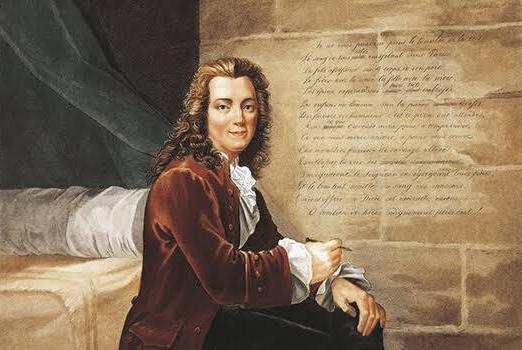
Voltaire & the paradox of Enlightenment: Liberty for some, inequality for others
KARACHI (TKP Feature): François-Marie Arouet, better known as Voltaire, is remembered as one of history’s most influential defenders of intellectual freedom. The French writer challenged religious intolerance, criticized censorship and questioned institutions that demanded obedience rather than reason. His writings helped shape the European Enlightenment, making him an enduring symbol of the right to question established authority.
Yet the legacy of Voltaire contains a contradiction that complicates his reputation. The man who championed religious tolerance and intellectual liberty also expressed deeply prejudiced views about race, supported racial hierarchies and invested in commercial ventures connected to colonial exploitation and the transatlantic slave trade.
Born in Paris in 1694, Voltaire’s commonly recorded birthday is November 21, although he himself claimed to have been born on February 20 of the same year. More than three centuries later, his intellectual contributions remain influential, but historians have increasingly examined the uncomfortable aspects of his worldview.
The most striking contradiction concerns his understanding of human differences.
Voltaire subscribed to polygenism, the theory that different human populations originated through separate acts of creation rather than sharing a common ancestry. He regarded racial differences as fixed and maintained a hierarchy that placed Europeans above other populations.
This was not simply an isolated observation in his writings. Historian Gianamar Giovannetti-Singh, in a 2022 peer-reviewed study published in the History Workshop Journal, argued that racial thinking remained a consistent feature of Voltaire’s intellectual work throughout his life.
The research also examined the relationship between these beliefs and Voltaire’s financial involvement in colonial commerce.
Voltaire held shares in the French Compagnie des Indes, a trading company involved in colonial commerce and the transatlantic slave trade. More significantly, documentary evidence examined by Giovannetti-Singh shows that Voltaire invested 10,000 livres in the San Jorge, a ship that transported 284 Africans abducted from the Guinea coast to Buenos Aires in 1752. Of those, 251 survived the voyage and were sold into slavery.
The discovery raises difficult questions about the relationship between Voltaire’s philosophical principles and his financial interests.
His literary work, however, also contained criticism of slavery. In his 1759 novella Candide, he depicted an enslaved African man in Suriname who had suffered mutilation under the colonial system. The character explains the human cost behind Europe’s consumption of sugar.
The episode is among the most memorable criticisms of colonial exploitation in eighteenth-century literature. Nevertheless, it does not erase the contradiction between Voltaire’s literary criticism and his documented commercial investments.
His political philosophy reveals another limitation in the popular image of Voltaire as a universal liberal.
Although he defended intellectual freedom and religious tolerance, he was not an advocate of democracy in the modern sense. According to the Stanford Encyclopedia of Philosophy, Voltaire remained a reform-minded monarchist throughout his life and was sceptical of republican and democratic politics.
He believed that an enlightened ruler, guided by reason and education, could reform society. His political vision therefore placed considerable confidence in educated leadership rather than equal participation in government.
This distinction is important because the Enlightenment was never a completely unified movement. Its thinkers disagreed over democracy, equality, religion and the distribution of political power. Voltaire’s commitment to liberty was significant, but it did not amount to support for every form of political or social equality.
His campaign for Jean Calas nevertheless demonstrated the practical importance of his ideas.
In 1762, Calas, a Protestant merchant in Toulouse, was executed after being convicted of murdering his son. Voltaire became convinced that religious prejudice had influenced the proceedings and began campaigning for a review of the case.
He investigated the circumstances, corresponded with influential figures and published arguments challenging the conviction. The case was reopened, the original judgment was overturned in June 1764, and Calas and his family were formally rehabilitated in March 1765.
The affair became one of the defining examples of Voltaire’s commitment to religious tolerance and judicial fairness. His Treatise on Tolerance, published in 1763, extended the campaign into a wider argument against religious persecution.
His 1759 work Candide similarly challenged philosophical complacency. Written in the aftermath of the devastating Lisbon earthquake of 1755, the novella questioned the belief that everything happens for the best in the best of all possible worlds. Through satire and absurdity, Voltaire exposed the distance between abstract philosophical optimism and the suffering experienced by ordinary people.
These achievements explain why Voltaire remains central to the history of the Enlightenment. His writings helped popularize scientific reasoning, challenged religious dogmatism and encouraged public criticism of institutional authority.
However, his legacy also raises questions about the limits of the Enlightenment itself. How could a movement that celebrated reason and human progress accommodate racial hierarchies and colonial exploitation among some of its most prominent thinkers?
The debate is not merely historical. In recent years, scholars and activists have increasingly reassessed the relationship between European intellectual traditions and colonialism, questioning whether the language of universal liberty was consistently applied to people outside Europe.
Voltaire’s record makes this reassessment particularly important. His criticism of religious persecution did not translate into an equally consistent defence of racial equality. His intellectual opposition to certain forms of injustice coexisted with financial participation in a colonial economic system that inflicted immense suffering.
Judging an eighteenth-century thinker exclusively by contemporary standards would overlook the historical circumstances in which he lived. But historical context should not prevent an honest examination of documented beliefs and actions.
Voltaire’s greatest legacy may therefore lie not in an image of intellectual perfection, but in the critical spirit he helped popularize.
If questioning established authority was central to his philosophy, then questioning Voltaire himself should not be considered a rejection of the Enlightenment.
It may be one of its most important continuations.