
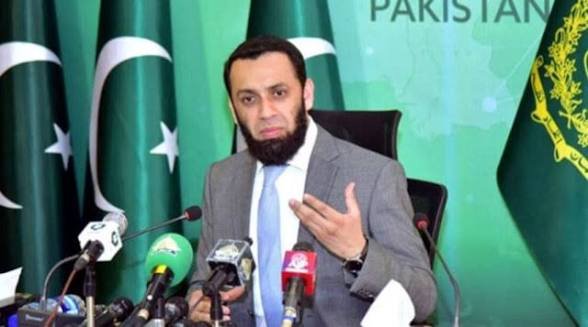
Govt to set up National Cyber Security Awareness Council: Tarar
ISLAMABAD (APP): Federal Minister for Information and Broadcasting Attaullah Tarar has called for making digital literacy a part of every campaign, curriculum and institution and proposed the establishment of a National Cyber Security and Social Media Awareness Council, saying that spread of disinformation and risks emanating from it are the biggest challenge of present era.
He said every institution in Pakistan should have a digital literacy cell and labeling of Artificial Intelligence (AI) generated content must be made mandatory.
The minister was addressing as chief guest the inaugural ceremony of Cyber Security Awareness Week 2026 organized by Pakistan Telecommunication Authority (PTA) on the theme of “Building a Safe, Secure and Resilient Cyberspace” on Saturday.
Chairman PTA Major General (Retd) Hafeez Ur Rehman, UNDP Resident Representative Dr. Samuel Rizk, UNDP’s Babar Yaqoob Fateh Muhammad, Chairperson PEMRA Ambrin Jan, representatives of various telecom companies and other important personalities were also present.
Addressing the ceremony, Tarar said spread of fake information and risks emerging from it are the biggest challenge of the current era. He said when global leaders were asked at the World Economic Forum in Davos about the biggest threat of current era, they termed spread of misinformation and risks arising from it as the biggest challenge, instead of nuclear war or climate change.
He said to tackle this challenge, it is necessary to understand Pakistan’s media landscape and the rapidly changing digital environment.
The minister said two major changes occurred in Pakistan’s media landscape. Earlier there was traditional media era including print media and radio, while in early 2000s private television channels were launched, and this evolution process moved forward in a very natural way.
With media evolution, regulatory frameworks also came into existence and we were ready for policy making, implementation and monitoring, however with arrival of social media and rapid changes in digital landscape, the country and society was not fully prepared for this new environment and rapidly changing technology, hence we could not keep pace with this speed and that is why effective regulatory framework could not be established.
He said when regulatory frameworks do not exist, implementation of laws and regulations also becomes a big challenge.
Tarar paid tribute to PTA and UNDP saying they have done commendable work regarding policy making, regulation, implementation and public awareness.
He said only one-week awareness campaign is not enough, continuous efforts are needed for it. He said in view of changes in media and digital technology, we now also have National Cyber Crime Investigation Agency (NCCIA) and Social Media Protection and Regulatory Authority.
He said these new institutions are also going through evolutionary stages. He said with rapid changes in technology, challenges and risks are also increasing, to tackle which a coordinated, comprehensive and joint strategy is needed.
He said awareness does not only mean running campaigns on social media or television or telling users what to do and what not to do, but awareness requires comprehensive change and reforms in the entire system.
He stressed need to include digital literacy in curriculum of schools, colleges and universities. He said a lot of work is being done in universities in this regard and fact-checking systems are also present now. Extensive research is also underway regarding fake news and misinformation.
He said there is no uniform curriculum of digital literacy in the country. There is need to introduce regular curriculum of digital literacy from primary, middle and high school level to universities so that children can be better informed about dangers of digital world and they can also be taught ways to deal with these challenges.
He said solution to this problem exists within the problem itself. In view of rapid changes in digital world, there is need to devise a research-based system under which curriculum also keeps getting updated along with rapid changes in technology. This work is not impossible, we can achieve this target.
He said digital literacy should be made compulsory for every citizen.
Tarar said we are also facing challenges of deepfake and Artificial Intelligence (AI). Among social media platforms, so far only TikTok has made labeling of AI-generated content mandatory for its content. He said we have to ensure through our regulatory framework that AI labeling is mandatory because user should know that the content he is watching is prepared through Artificial Intelligence.
He said it is our responsibility that digital literacy should be made part of every campaign, every curriculum and every institution, solution of problem lies within it. Every institution of Pakistan should have a digital literacy cell, we will also have to train our officers.
He said this is an era where large-scale awareness cannot compete with problem facing us. Today’s era is era of specific messaging, so we cannot adopt same policy or same procedure for all of us.
He said media campaigns and public awareness do not prove effective in this manner, every user, every citizen wants to be addressed directly, we are living in era of micro-influencers.
Tarar said while running campaign for any sector, it is necessary to search that specific class where micro-influencers exist and they have ability to convey this message. Therefore we have to ensure that right message, in right format, is delivered to right kind of audience.
He said how can this work be done? Solution to this problem exists within social media system itself because solution is hidden within it. Regarding cyber security, none of our citizens realize that even one click can become cause of interference in their private life. Through one click they can hand over all their data to platform they are using.
Proposing establishment of National Cyber Security and Social Media Awareness Council, Attaullah Tarar said this council can include all institutions present here, relevant provincial governments, relevant ministries and divisions of federal government. He said suggestions can also be sought from various stakeholders. He assured on behalf of Government of Pakistan and Ministry of Information and Broadcasting that full cooperation will be provided in establishment of this council so that awareness can be created at every level throughout year.
He appreciated excellent work done by UNDP saying UNDP is partner of Ministry of Information and Broadcasting and various training programs are also ongoing with its cooperation.
He said regarding various aspects of cyber security and risks arising from it, we need to adopt more coordinated, harmonious and whole-of-government joint strategy so that correct access to every citizen can be obtained.
He said it is our responsibility and we are present here for a purpose. He said if along with creating awareness among citizens, they are also provided solutions to these problems, it will be a great national service.
He said new sectors have been established in Ministry of Information and Broadcasting. When he took charge of ministry, we had no existence at digital level, Pakistan’s first Digital Communication Department was established in Ministry of Information which is now progressing, it is now being taken to regional level.
He said we have corporate culture, fact-check systems exist and we have highly dynamic team whose most members belong to Generation Z and they are aware of these challenges. He said we are making our best efforts to create awareness but this is also not enough from our side because if we do not cooperate and do not create more coordination, we will not be able to achieve effective results.
He said he was happy to know that National Cyber Crime Investigation Agency (NCCIA) has now taken shape of an institution, it has started its work, this will also greatly help PTA, consultation in this regard is ongoing between PTA, Ministry of Information Technology and Ministry of Information and Broadcasting.
He said we are in contact with various social media platforms, if these new institutions whether Social Media Protection and Regulatory Authority or NCCIA can also be facilitated through this council, this is way forward.
The minister said at end of this seminar we can also hold few meetings and announce establishment of this council in one or two weeks to make our coming generations more secure.