
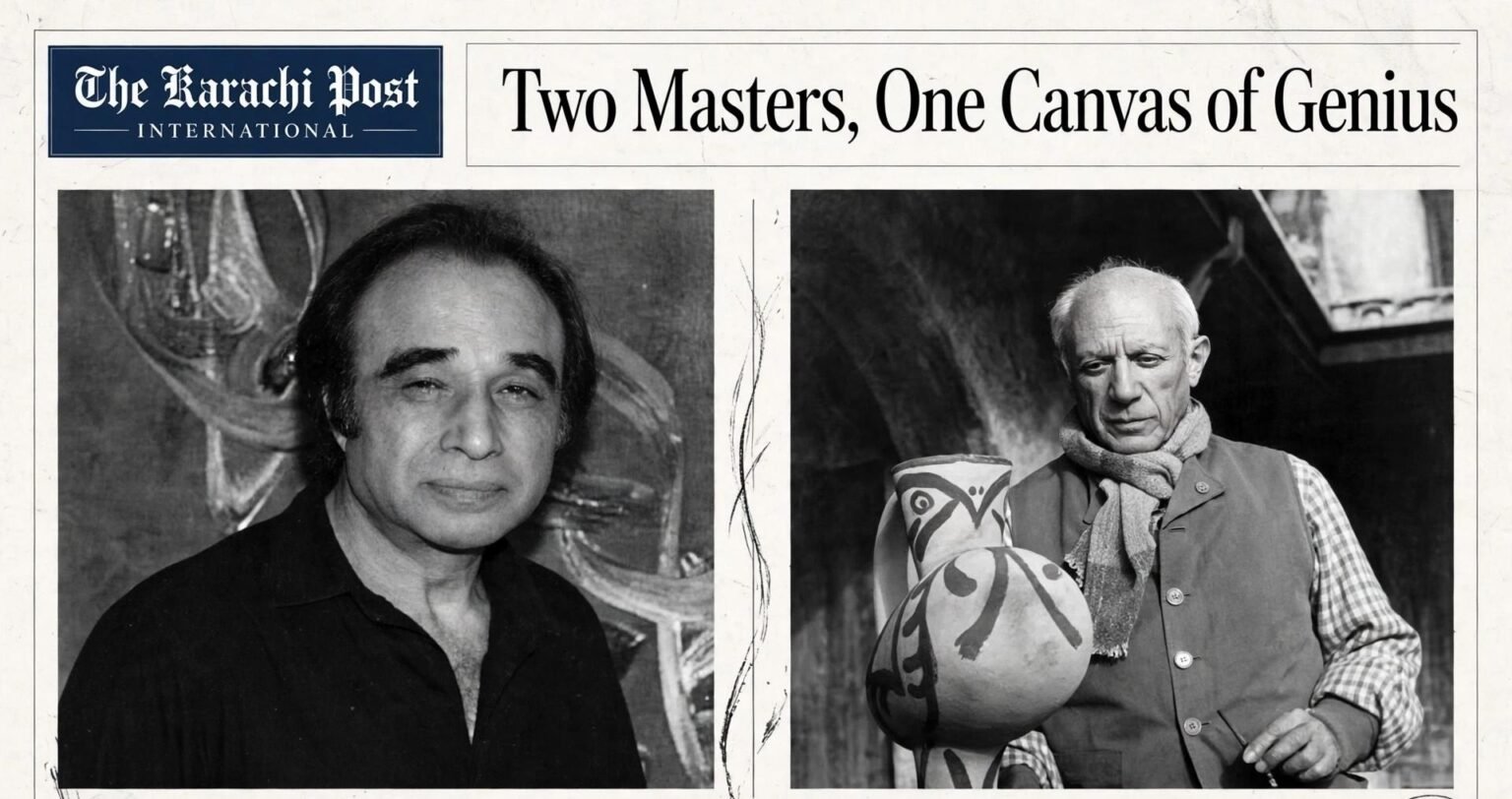
Two Masters, One Canvas: Picasso and Gulgee’s enduring artistic legacies
By Hassan Tanvir Niazi
On October 25, the art world remembers two remarkable figures whose works transcended geographical boundaries, cultural traditions and conventional definitions of artistic expression: Pablo Picasso, the Spanish-born revolutionary of modern art, and Ismail Gulgee, Pakistan’s internationally acclaimed painter, calligrapher and sculptor.
Born 45 years apart in terms of their respective centenaries, the two artists belonged to different cultural landscapes, yet shared an extraordinary determination to challenge artistic conventions. Picasso, born on October 25, 1881, in Málaga, Spain, transformed the visual language of modern Western art. Gulgee, born on October 25, 1926, in Peshawar, emerged as one of Pakistan’s most distinctive artistic voices, bringing together abstraction, calligraphy and the movement of colour.
Their artistic journeys demonstrate that creativity is not confined to a particular geography or tradition. It is an evolving language through which individuals interpret the world, question established forms and give expression to experiences that words alone cannot fully communicate.
Picasso: The revolutionary who changed how the world sees
Picasso’s contribution to modern art lies not merely in the extraordinary volume of his work, but in his willingness to challenge the assumption that painting must reproduce reality as the eye perceives it.
Trained in the academic traditions of drawing and painting, Picasso demonstrated exceptional technical ability from an early age. His subsequent artistic development, however, took him far beyond conventional representation. Moving between distinct creative periods, he explored human suffering, loneliness, love, conflict and the complexities of modern life.
His Blue Period, characterized by sombre colours and melancholic figures, reflected a profound emotional intensity. His Rose Period introduced warmer tones and subjects drawn from performers and circus life. Later, his experiments with Georges Braque helped establish Cubism, an artistic movement that broke objects and figures into geometric forms and presented multiple perspectives within a single composition.
The 1907 painting Les Demoiselles d’Avignon became a landmark in the development of modern art, challenging established ideas about perspective, representation and the human figure.
Picasso’s 1937 masterpiece Guernica, meanwhile, gave monumental expression to the suffering inflicted by war. Created in response to the bombing of the Basque town of Guernica during the Spanish Civil War, the painting remains one of the most powerful artistic condemnations of violence against civilians.
His legacy rests on a willingness to experiment relentlessly. Painting, sculpture, ceramics, printmaking and other media became avenues through which he continually reimagined artistic possibility.
Picasso did not simply change what artists painted. He helped change how they understood the act of painting itself.
Ismail Gulgee: Where abstraction meets spirituality
If Picasso disrupted the visual conventions of Western art, Ismail Gulgee developed a distinctive artistic vocabulary that connected modern abstraction with the cultural and calligraphic traditions of the Islamic world.
Born in Peshawar in 1926, Gulgee initially pursued a career in engineering. He graduated from Aligarh University and subsequently studied at Columbia University and Harvard University in the United States. Despite his academic training, his fascination with drawing and painting continued to grow, eventually leading him to abandon engineering for a life devoted to art.
His transition was significant. At a time when Pakistan was developing its identity as a new nation, Gulgee helped establish an artistic language that was modern in form while drawing inspiration from the region’s rich cultural heritage.
His work became particularly recognisable for its energetic brushstrokes, vivid colours, metallic gold and silver surfaces, and abstract interpretations of Arabic calligraphy. Rather than treating calligraphy simply as written language, Gulgee transformed its flowing lines and rhythmic structures into visual compositions.
The resulting paintings occupy a fascinating space between abstraction and spirituality. Letters appear to move across the canvas, becoming forms of energy, movement and expression. Their significance extends beyond the literal meaning of the words, inviting viewers to engage with the rhythm and emotional power of the image.
Gulgee was also an accomplished portraitist, producing works depicting prominent political leaders, monarchs and international dignitaries. His artistic versatility extended to sculpture, mosaics and architectural commissions. Among his notable contributions were the calligraphic elements associated with Faisal Mosque in Islamabad, including its distinctive mihrab.
His work received international recognition, while his establishment of the Gulgee Museum in Karachi in 2000 reflected his commitment to preserving art and creating opportunities for emerging artists.
Gulgee died in Karachi on December 19, 2007, alongside his wife, Zarine, in a tragedy that shocked Pakistan’s artistic community. Yet his work continues to occupy an important place in the country’s cultural history.
Different worlds, a shared spirit of experimentation
Comparing Picasso and Gulgee does not require placing their achievements on the same artistic scale. Their importance lies partly in the different traditions from which they emerged and the different questions their works addressed.
Picasso’s art frequently dismantled familiar visual structures to reveal alternative ways of seeing. Gulgee’s abstraction often drew upon the movement of calligraphy, the resonance of spiritual language and the expressive possibilities of colour.
One challenged the established grammar of representation; the other developed a distinctive synthesis of modern expression and inherited cultural forms.
Both, however, demonstrated that artistic traditions need not remain static. They can be questioned, reinterpreted and transformed without losing their capacity to communicate across generations.
Their careers also underline an important distinction between imitation and influence. Great artists do not merely repeat what came before them. They absorb their surroundings, experiment with available materials and techniques, and develop a personal vocabulary through which their experiences become visible.
Remembering art beyond anniversaries
For Pakistan, Gulgee’s birth anniversary carries particular significance. His career offers a reminder that Pakistani artists can engage with international modernism while drawing confidence from their own cultural and intellectual traditions.
His achievement deserves to be remembered not only through his celebrated portraits and calligraphic canvases, but also through sustained efforts to preserve his work, support artistic education and introduce younger audiences to his contribution.
Picasso’s continuing influence similarly demonstrates how a single artist’s willingness to challenge convention can reshape the direction of an entire field.
Ultimately, the significance of October 25 extends beyond celebrating two birthdays. It is an opportunity to reflect on art’s enduring power to cross borders, unsettle assumptions and preserve ideas in forms that outlive their creators.
Picasso and Gulgee followed different paths, spoke through different visual languages and belonged to different artistic worlds. Yet their legacies converge in one essential principle: art remains alive when it dares to explore the unknown.
Their canvases continue to speak—not because they offer a final interpretation of the world, but because they invite every new generation to look again.
A scholarly essay to conceive the art of Picasso and Gulgee.