
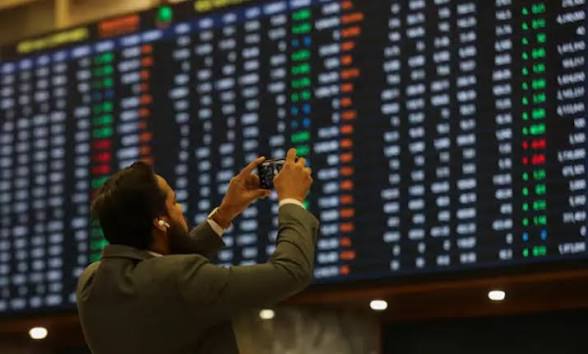
Geopolitical tensions, political uncertainty trigger selling pressure at PSX
KARACHI (TKP Report): The Pakistan Stock Exchange (PSX) came under renewed selling pressure on Wednesday as escalating geopolitical tensions surrounding the Strait of Hormuz and growing domestic political uncertainty weighed on investor sentiment, erasing early gains and pushing the benchmark KSE-100 Index into negative territory.
The market opened on a positive note, gaining 57 points to reach 177,575. However, the initial momentum proved short-lived as selling intensified during the session. The benchmark index subsequently fell to 176,679.17, shedding 838.56 points, or 0.47 percent.
The index touched an intraday high of 177,719.05 and a low of 176,591.45, reflecting cautious trading and growing investor concerns.
Developments surrounding the Strait of Hormuz remained a significant concern for market participants following reports of multiple attacks on commercial vessels and oil tankers in and around the strategic waterway.
Recent incidents included an attack on the Panama-flagged LPG tanker Tara Gas near Oman’s Musandam Peninsula, forcing its crew to abandon the vessel. The UK Maritime Trade Operations agency also reported a second attack on a tanker north of Khasab, Oman, with its crew subsequently reported missing.
Iranian naval authorities have separately claimed that several tankers struck naval mines after allegedly violating designated maritime routes. However, responsibility for individual incidents has not been independently established in every case.
The developments have heightened concerns about the security of international shipping and the potential disruption of energy supplies through the Strait of Hormuz, a critical route for global oil and gas transportation.
For Pakistan, prolonged disruption in the region could increase imported energy costs, widen the trade deficit and create additional pressure on foreign exchange reserves and domestic inflation.
Domestic political uncertainty has further complicated the investment environment following an exchange of statements between Pakistan Peoples Party Chairman Bilawal Bhutto-Zardari and Federal Information Minister Attaullah Tarar.
Addressing a Meet the Press session at the Karachi Press Club on Tuesday, Bilawal called for a political reset and expressed concern over the country’s economic situation. He warned that financial pressures were forcing families to make difficult choices between food, children’s education and other essential needs.
Tarar responded by reminding the PPP chairman that his party was part of the coalition government and urging political engagement to address governance and economic challenges.
Although the political exchange cannot independently be established as the direct cause of the market decline, the public differences between coalition partners have added to investor concerns about political stability and economic policymaking.
Interestingly, the selling pressure comes despite improvements in Pakistan’s external-sector indicators.
According to the State Bank of Pakistan (SBP), the country’s current account recorded a surplus of $39 million in October 2026, reversing a deficit of $371 million in September and a deficit of $307 million in October last year.
Workers’ remittances increased to approximately $3.89 billion during October, supporting the external account. The cumulative current account deficit during July-October FY27 narrowed to $850 million, compared with $1.062 billion in the corresponding period last year.
Foreign direct investment also showed improvement. Net FDI increased 32 percent year-on-year to $216 million in October 2026, compared with $164 million a year earlier. During the first four months of FY27, cumulative FDI reached approximately $936 million, up from $764 million in the corresponding period last year, representing growth of around 22 percent.
These figures indicate improving external-sector conditions, although the sustainability of the recovery remains dependent on stronger exports, investment and stable foreign exchange inflows.
The latest market movement suggests that investors are weighing these improving economic indicators against geopolitical risks, domestic political uncertainty and the possibility of renewed pressure on Pakistan’s import bill.
Financial expert Sheheryar Butt’s assessment of the ongoing market weakness would help establish whether the selling represents temporary profit-taking or a broader reassessment of investment risks.
The coming sessions will be important in determining whether improving external-sector fundamentals can restore investor confidence amid continuing regional and domestic uncertainties.