
The Poet-King’s unfinished Ghazal
By Hassan Tanvir Niazi
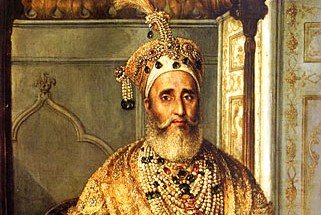
Today, the sub-continent quietly marks the birth anniversary of Abu Zafar Sirajuddin Muhammad Bahadur Shah Zafar. Born on October 24, 1775, he was a man never destined for absolute rule, yet fate cast him as the tragic protagonist in the twilight of an empire. Today, he is remembered not as a conqueror who expanded frontiers with iron and blood, but as a poet-king whose verse mirrored the fractures of his realm, and whose final days in exile came to symbolize the heartbreaking end of an era.
To understand Zafar is to understand the Delhi of the mid-19th century—a city where the physical authority of the Mughal Empire had shrunk almost entirely to the red sandstone walls of the Lal Qila. Beyond the palace, the British East India Company held the reins of true power. Yet, within those walls, Zafar presided over a magnificent cultural renaissance. The Emperor was a masterful calligrapher, a devout Sufi, and a brilliant Urdu poet. His court was a sanctuary for the greatest literary minds of the age, including Mirza Ghalib, Ibrahim Zauq, and Momin Khan Momin. Under his patronage, the mushaira (poetry symposium) became the heartbeat of Delhi, turning the dying empire into a vibrant capital of verse.
However, the tranquility of this literary haven was shattered in May 1857. When sepoys from Meerut mutinied against their British officers and marched into Delhi, they converged on the Red Fort. They sought a symbol of legitimate authority to unite a fragmented uprising, and they found it in the 82-year-old Emperor. Zafar was a reluctant rebel. He understood the overwhelming might of the East India Company and the chaotic nature of the rebel forces. Yet, moved by a sense of duty to his people and the legacy of his ancestors, he accepted the leadership of the uprising, signing his name to a rebellion that would change the course of history.
The siege of Delhi was brutal. For four months, the city held out, but by September 1857, British forces breached the gates. The retribution was swift and merciless. Delhi was plundered, and its residents faced widespread slaughter. Zafar sought refuge at the magnificent tomb of his ancestor, Emperor Humayun. It was there that Major William Hodson captured him. In a final, chilling act of cruelty, Hodson shot Zafar’s sons and grandson at point-blank range near the Delhi Gate—a spot known to this day as Khooni Darwaza (The Bloody Gate)—and reportedly presented their severed heads to the captive Emperor.
The British stripped Zafar of his titles and put him on trial for treason in his own palace. The verdict was a foregone conclusion. The last custodian of the Timurid dynasty was sentenced to lifelong exile. In the dead of night, the elderly, frail Emperor, accompanied by his wife Zeenat Mahal and a small retinue, was smuggled out of Delhi. Their destination was Rangoon, Burma—a distant, tropical outpost where the British hoped he would be entirely forgotten.
In Rangoon, Zafar was confined to a modest, mud-floored wooden dingy under strict military guard. The British denied him pen, ink, and paper, fearing that his words might still ignite the embers of resistance back home. But they could not silence the poet within him. Denied the tools of his craft, Zafar used burnt charcoal to scratch his final, heartbreaking verses onto the whitewashed walls of his prison cell.
It was during these dark years of isolation that he penned his most famous ghazal, a profound lamentation on mortality, displacement, and the agony of exile. His most enduring couplet remains a universal anthem for the displaced:
“Kitna hai badnaseeb Zafar, dafn ke liye,
Do gaz zameen bhi na mili, koo-e-yaar mein.”
The lines carry a haunting literal truth. Zafar had carefully selected and designed his own burial plot years earlier in Delhi, located in the peaceful courtyard of the Zafar Mahal in Mehrauli, adjacent to the shrine of the Sufi saint Khwaja Qutbuddin Bakhtiyar Kaki. That empty grave in Delhi stands today as a silent, powerful monument to unfulfilled longing.
When Zafar breathed his last on November 7, 1862, at the age of 87, the British buried him quickly in an unmarked grave near his prison quarters, intentionally flattening the earth above it so no shrine could be built. For over a century, the exact location of his remains stayed hidden, until a chance excavation in 1991 revealed the brick-lined crypt.
Two hundred and fifty-one years after his birth, Bahadur Shah Zafar’s legacy endures far beyond the geopolitical ruins of the Mughal Empire. He survives in the ink of every Urdu poet, in the shared cultural memory of the subcontinent, and in the timeless verses that continue to echo the pain of exile. He entered history as a reluctant emperor, but departed it as the immortal voice of a fallen Delhi.