
Board of Investment merged into SIFC
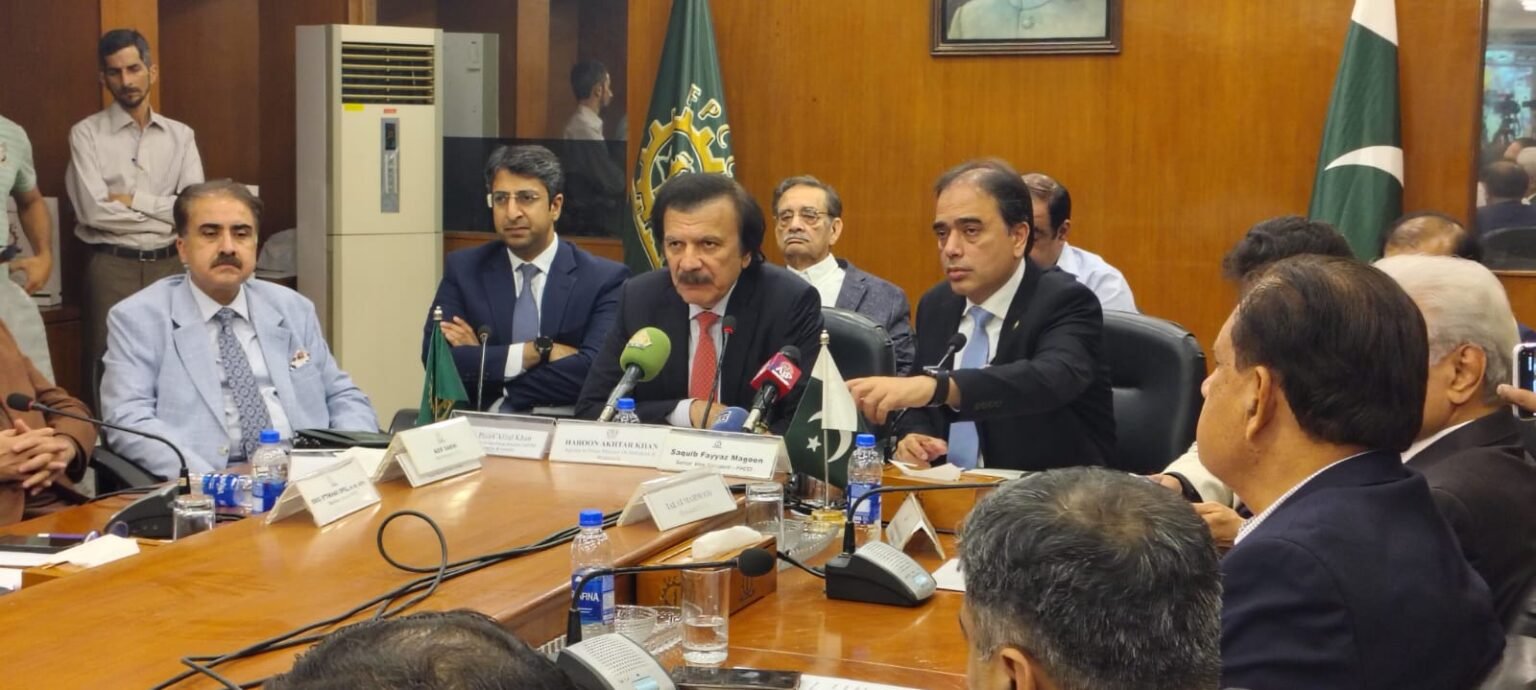
KARACHI (TKP Report): Adviser to the Prime Minister on Industries and Production Haroon Akhtar Khan has revealed that the Board of Investment (BOI) has been merged into the Special Investment Facilitation Council (SIFC) and will now function as part of SIFC to provide a complete single window operation for investors.
He made the revelation during his visit to the Federation House Karachi on Wednesday, where he was received by FPCCI Senior Vice President Saquib Fayyaz Magoon and Vice Presidents Aman Paracha and Asif Sakhi. Special Assistant to the Prime Minister on Commerce and Industry Rana Ehsan Afzal was also present on the occasion.
Addressing the business community, Haroon Akhtar said the overall economic outlook is improving and Pakistan has the potential to achieve 6.5 percent economic growth. He said the biggest challenge remains that the balance of payments gets disturbed when growth exceeds 4 percent, and even foreign direct investment has not been able to offset this imbalance.
He said the current energy prices in Pakistan are not competitive and the country cannot become competitive in the region with such rates. He recalled that in the 1990s industrialists were setting up new factories, but now new factories are not being established, though conditions in existing factories are improving.
The Adviser said every new technology has the potential to make Pakistan its hub, but the situation will not improve until exports are increased. He noted that exports are not growing at the pace of imports and if manufacturing does not grow and industry does not become 26 percent of GDP, issues will persist. Pakistan’s exports are not even 10 percent of GDP, he added.
Haroon Akhtar said past governments and NAB have caused severe damage to the economy, adding that no major business house is there which has not faced NAB. He said NAB as an institution has now improved.
He said real estate should contribute 12 percent to GDP, not 25 percent, and an increase in interest rate will create difficulties for manufacturing. He said despite rising crude oil prices, electricity prices have not increased due to solar panels. He also credited the Field Marshal for efforts for peace in the world which reduced intensity of war.
On ease of doing business, the Adviser said the government is working to facilitate businesses and taking steps to ease licensing and amending the Companies Act, with 70 percent work already completed. He said globally regulators are meant to facilitate businesses, but in Pakistan, unchecked increase in regulators has raised cost of doing business. Both the Prime Minister and Field Marshal are interested in reducing cost of doing business, and provinces are also working on it swiftly, he said.
PM’s Coordinator for Commerce and Industry Rana Ihsaan Afzal Khan said the next budget will be made better for the business community.
Earlier, FPCCI Senior Vice President Saquib Fayyaz Magoon said exports are stagnant mainly due to high energy costs and no long-term policy is formulated in the budget. Energy policies keep changing frequently, and Pakistan has the highest interest rate in the region, he added.
He said the burden of shifting of large units to alternative energy falls on small industries and it has become clear that IPPs agreements cannot be reviewed. The only solution is that the government should reduce electricity prices, he said.
Magoon warned that India-EU Free Trade Agreement will start from January and if Pakistan does not focus on its cost of doing business, it will be a big challenge for its exports.
He said the government is moving towards digital invoicing and digital monitoring, but demanded that digital monitoring should not be done in the exports sector, as any leaked video is misused by India on international platforms.
He said Sindh government collects Rs. 200 billion annually as cess tax from importers, while Rs. 65 billion was spent on Shara-e-Bhutto. He demanded construction of a bypass for Karachi and access to monitoring of cess tax.
He said there is no mechanism for regulation of Export Facilitation Scheme (EFS) and while FPCCI supports EFS, it is being misused.