
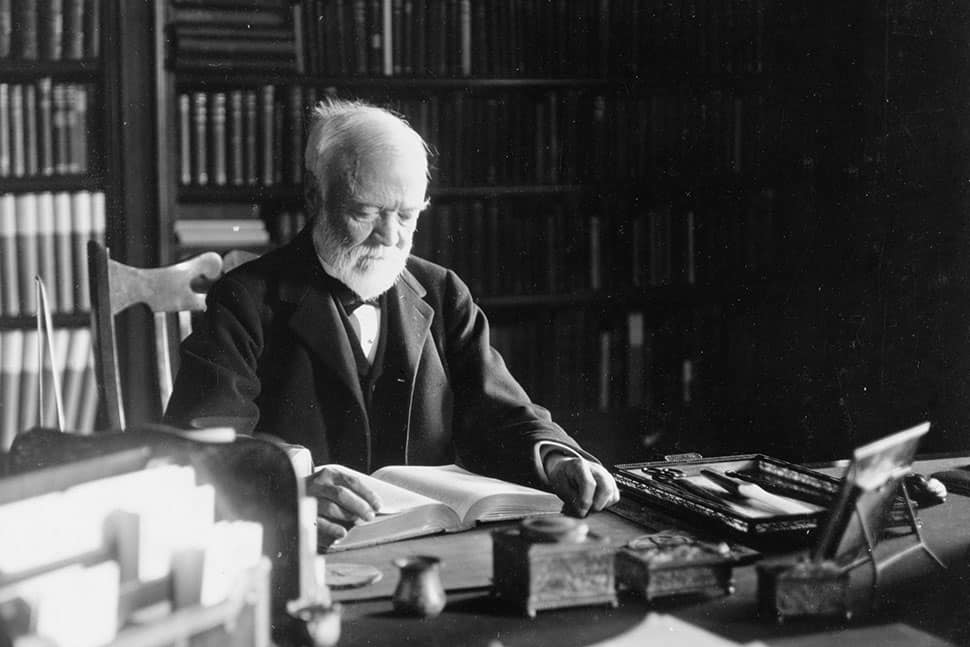
Andrew Carnegie: The dark side of the billionaire who built libraries
He funded thousands of libraries and became one of history’s greatest philanthropists. But behind Andrew Carnegie’s charitable legacy was a steel empire whose confrontation with organized labour left workers dead and exposed the contradictions of American capitalism.
KARACHI (TKP Feature): Andrew Carnegie is celebrated as the Scottish immigrant who rose from poverty to become one of the world’s richest industrialists before giving away much of his fortune to public causes. His name is associated with libraries, universities, education and philanthropy.
Yet the story of Carnegie’s wealth has a darker chapter. His steel empire was built through aggressive business expansion, fierce competition and a determination to weaken organized labour. The most notorious example was the Homestead Strike of 1892, when a dispute between workers and management escalated into a deadly confrontation.
The episode raises an uncomfortable question about one of capitalism’s most celebrated figures: could a man who believed the wealthy had a moral duty to serve society also support business practices that came at a considerable cost to workers?
Homestead: When steel workers challenged the billionaire
Carnegie acquired the Homestead steel works near Pittsburgh, Pennsylvania, in 1883. The facility eventually became a central part of his expanding steel business.
Its skilled workers belonged to the Amalgamated Association of Iron and Steel Workers, a powerful labour union that had negotiated wages and workplace conditions with management.
By 1892, the existing labour agreement was approaching its expiry. Carnegie Steel management wanted lower wages and greater control over the plant, while the union sought to protect its position.
Henry Clay Frick, Carnegie Steel’s chairman and general manager, took charge of negotiations. He adopted a hard-line approach, demanding concessions and preparing to operate the plant without the union.
Management built a fortified perimeter around the facility, which workers called Fort Frick, and hired approximately 300 Pinkerton agents to protect the plant and facilitate the arrival of replacement workers.
On July 6, 1892, the Pinkerton agents approached the mill by river. Workers and local residents gathered to prevent them from entering. Gunfire broke out, turning the confrontation into a prolonged and bloody battle.
The Pinkertons eventually surrendered. Seven workers and three Pinkerton agents were killed, while many others were injured.
The violence did not end the dispute. Pennsylvania’s National Guard arrived on July 12, secured the plant and enabled management to resume operations with replacement workers. The strike eventually collapsed, and organized labour lost its position at Homestead.
The defeat was a major setback for the union movement in the American steel industry.
Carnegie was in Scotland, but his correspondence tells another story
Carnegie was in Scotland when the confrontation took place. His absence later became part of the controversy, as critics questioned why the owner of the company was away during such a consequential labour dispute.
However, historical correspondence between Carnegie and Frick provides a clearer picture of his involvement.
In a May 1892 letter, Carnegie told Frick: “We are with you to the end.” The correspondence, reproduced by PBS’s American Experience, demonstrates that Carnegie supported Frick’s preparations to confront the union.
His position was also evident after the violence. In a telegram sent on July 7, Carnegie instructed Frick: “Never employ one of these rioters. Let grass grow over works.”
These messages complicate Carnegie’s later public expressions of distress over the bloodshed. Although Frick directed the operation on the ground, Carnegie was not simply an uninvolved owner who happened to be abroad.
His support for the management strategy makes his responsibility for the confrontation an enduring subject of historical debate.
The Gospel of Wealth and the contradiction of philanthropy
Perhaps the most striking contradiction in Carnegie’s legacy lies between his business practices and his philosophy of wealth.
In 1889, he published The Gospel of Wealth, an influential essay arguing that wealthy individuals had a responsibility to use their fortunes for the general good.
Carnegie believed that excessive wealth should not simply be inherited or accumulated indefinitely. Instead, the rich should act as trustees of their fortunes, directing resources towards education, libraries, medical institutions and other public benefits.
His famous argument was that “The man who dies thus rich dies disgraced.”
Carnegie subsequently became one of history’s most prominent philanthropists. According to the Carnegie Corporation of New York, he contributed approximately $56 million towards the construction of 2,509 public libraries.
His philanthropy also supported universities, scientific research, cultural institutions and other educational initiatives.
These contributions were substantial and transformed access to knowledge for millions of people.
But his philosophy raises a difficult question: if wealthy individuals have a responsibility to improve society, should that responsibility also extend to the workers whose labour helps generate their fortunes?
At Homestead, the answer appeared far less generous than Carnegie’s public philosophy suggested.
The human cost of industrial capitalism
Carnegie’s rise coincided with America’s transformation into an industrial powerhouse. Steel was essential to railway expansion, bridges, factories and the construction of modern cities. His investments in technology, production efficiency and industrial integration helped make his company a dominant force.
But industrial progress also brought dangerous workplaces, demanding production schedules and bitter disputes over wages and workers’ rights.
Homestead demonstrated how far a powerful corporation could go to defeat organized labour. The company’s victory weakened union representation at the plant and became a warning to workers elsewhere in the steel industry.
The episode also exposed the unequal balance of power between industrial owners and employees. While management had the financial resources to hire private security and secure government intervention, workers faced the possibility of losing their livelihoods if they resisted.
A fortune, two legacies
In 1901, Carnegie sold his steel interests to financier J.P. Morgan in a transaction valued at approximately $480 million, helping create the United States Steel Corporation.
He subsequently devoted much of his life and fortune to philanthropy. His libraries and educational institutions remain an enduring part of his legacy.
Carnegie died in 1919, leaving behind two histories that are difficult to separate: that of a philanthropist who expanded public access to knowledge and that of an industrialist whose company helped crush organized labour at Homestead.
His achievements deserve recognition, but so does the historical record of the people who worked in his factories.
More than a century later, Carnegie’s life remains relevant to debates about billionaires, corporate responsibility, workers’ rights and wealth inequality.
His story reminds us that the value of a fortune cannot be judged only by how much of it is eventually donated. It must also be examined through the conditions under which it was accumulated.
Andrew Carnegie helped build libraries that opened doors to knowledge for millions. But the Homestead Strike revealed the human conflict behind the industrial empire that financed them.
That contradiction is perhaps the most important part of his legacy.