
Bilawal fears economic crisis, says families forced to choose between food & children’s education
KARACHI (TKP Report): Pakistan Peoples Party (PPP) Chairman Bilawal Bhutto Zardari has expressed serious concern over the country’s economic situation, warning that mounting financial pressures are forcing ordinary families to make difficult choices between meeting basic household needs, educating their children and accessing healthcare.
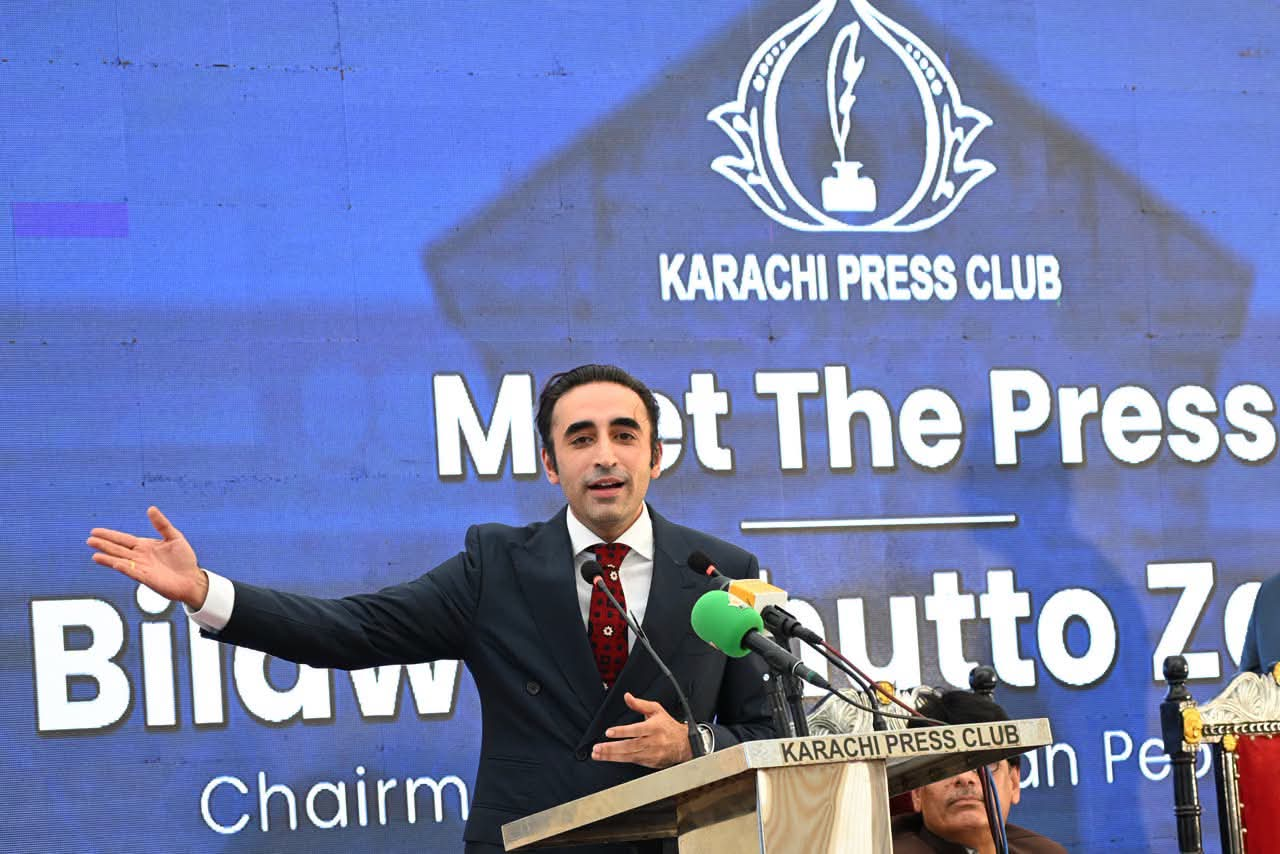
Addressing a Meet the Press session at the Karachi Press Club on Tuesday, Bilawal said he had witnessed several difficult periods in Pakistan’s history but had never encountered circumstances as challenging as those confronting the country amid the prevailing global situation.
“I am myself frightened by the economic crisis. What will happen to the people of Pakistan under these circumstances?” he said, expressing concern over the financial difficulties facing households.
His remarks highlighted the growing pressure on ordinary citizens, particularly families struggling to manage essential expenses amid inflation, rising living costs and economic uncertainty.
Bilawal pointed to the difficult choices confronting households, including whether to spend limited resources on children’s education or food. He also highlighted the financial burden of electricity bills, saying people had become apprehensive even about opening their monthly bills.
He drew attention to the difficulties faced by families in arranging medical treatment for elderly relatives while managing routine household expenditures.
The PPP chairman’s comments placed the human cost of economic hardship at the centre of his address, arguing that national political discussions must give greater attention to the everyday difficulties experienced by ordinary Pakistanis.
He said political leaders needed to focus on the problems of the population rather than allow political confrontation to dominate the national agenda.
Global uncertainty adds to economic concerns
Bilawal linked Pakistan’s economic vulnerability to the deteriorating international environment, particularly geopolitical tensions and the ongoing conflict in the Middle East.
He warned that the economic consequences of international conflicts could create additional difficulties for Pakistan, urging the government to prepare for their potential impact.
Pakistan’s exposure to external economic shocks remains an important concern because of its dependence on imported energy and the sensitivity of its external account to international commodity prices.
Any sustained increase in global oil prices can raise the country’s import bill, increase pressure on foreign exchange requirements and potentially translate into higher domestic transportation, electricity and production costs.
For households already struggling with high living expenses, another round of external price pressures could make financial management more difficult.
Bilawal said the government should concentrate on preparing the country for these challenges instead of opening new political fronts or creating additional confrontation.
He argued that Pakistan was facing serious geopolitical and economic difficulties and required internal political stability to respond effectively.
Political instability and economic governance
The PPP chairman’s economic concerns were closely connected with his call for a broader political reset.
He maintained that the country could not effectively address its challenges without restoring confidence in parliament and bringing opposition parties into the political process.
Bilawal specifically said Pakistan could not function without the Pakistan Tehreek-e-Insaf (PTI), describing it as a political stakeholder and a reality that could not be ignored.
He called for restoring the confidence of PTI, its founder Imran Khan and other opposition leaders in the parliamentary system.
According to Bilawal, political reconciliation was necessary to enable elected representatives to work together on issues affecting the population.
He said the government’s responsibility was not merely to maintain its parliamentary position but also to create conditions in which opposition parties could participate meaningfully in legislation, parliamentary committees and national policymaking.
The PPP chairman argued that government and opposition should be able to debate, disagree and ultimately find common ground on important national questions.
He also urged the government to address electoral grievances and introduce reforms before the next general elections, saying disputed elections could produce a parliament that struggled to command public confidence.
His proposed political reset included electoral reforms, restoration of opposition representation, an end to political victimisation and greater institutional accountability.
Economic hardship requires attention beyond political disputes
Bilawal also criticised the use of accountability institutions for political purposes, saying the country needed genuine action against corruption rather than politically motivated proceedings.
He argued that accountability should not be limited to politicians and that the role of bureaucracy in public-sector decisions also needed scrutiny.
He suggested that technology and digitisation could help reduce corruption and improve transparency in government operations.
His comments reflected a broader argument that institutional weaknesses and political instability could undermine the country’s ability to address economic problems.
He called for political leaders to move beyond the cycle of confrontation and focus on the challenges facing the country.
Government urged to prepare for external shocks
The PPP chairman particularly cautioned against ignoring the potential economic consequences of the Middle East conflict.
For Pakistan, developments in the region carry implications extending beyond diplomatic and security considerations. International energy prices, shipping costs and disruptions to trade routes can influence domestic economic conditions.
An increase in imported fuel costs can put pressure on the current account, complicate inflation management and increase the operating expenses of businesses and industries.
Higher energy costs can also affect transport, manufacturing and agricultural supply chains, eventually placing additional pressure on consumers.
Bilawal urged the government to create a political environment conducive to addressing these challenges, arguing that the country needed cooperation rather than further confrontation.
He also called for the revival of political dialogue on counterterrorism, saying security challenges required cooperation among all political parties.
A wider question about Pakistan’s economic direction
Bilawal’s remarks raise a broader question about the relationship between political stability, economic management and household welfare.
While his address did not include a detailed economic programme, fiscal proposals or quantified estimates of the financial pressures facing households, his emphasis remained on the consequences of economic difficulties for ordinary citizens.
His references to food, education, electricity and healthcare highlighted the competing demands on household budgets and the difficulties faced by families attempting to maintain basic living standards.
For businesses and investors, political uncertainty and geopolitical developments also remain relevant to decisions involving investment, production and expansion.
The government faces the challenge of managing domestic economic priorities while remaining exposed to international developments that can affect energy prices, trade and external financing requirements.
Bilawal said Pakistan needed political understanding and collective action to confront these challenges.
His central message was that political disagreements should not prevent the country from addressing the economic difficulties facing its population.
He urged political stakeholders to work towards a more stable system capable of responding to domestic hardships and external economic pressures, warning that the country’s challenges required cooperation rather than further political confrontation.