
Karachi Port at heart of Global Maritime Dialogue
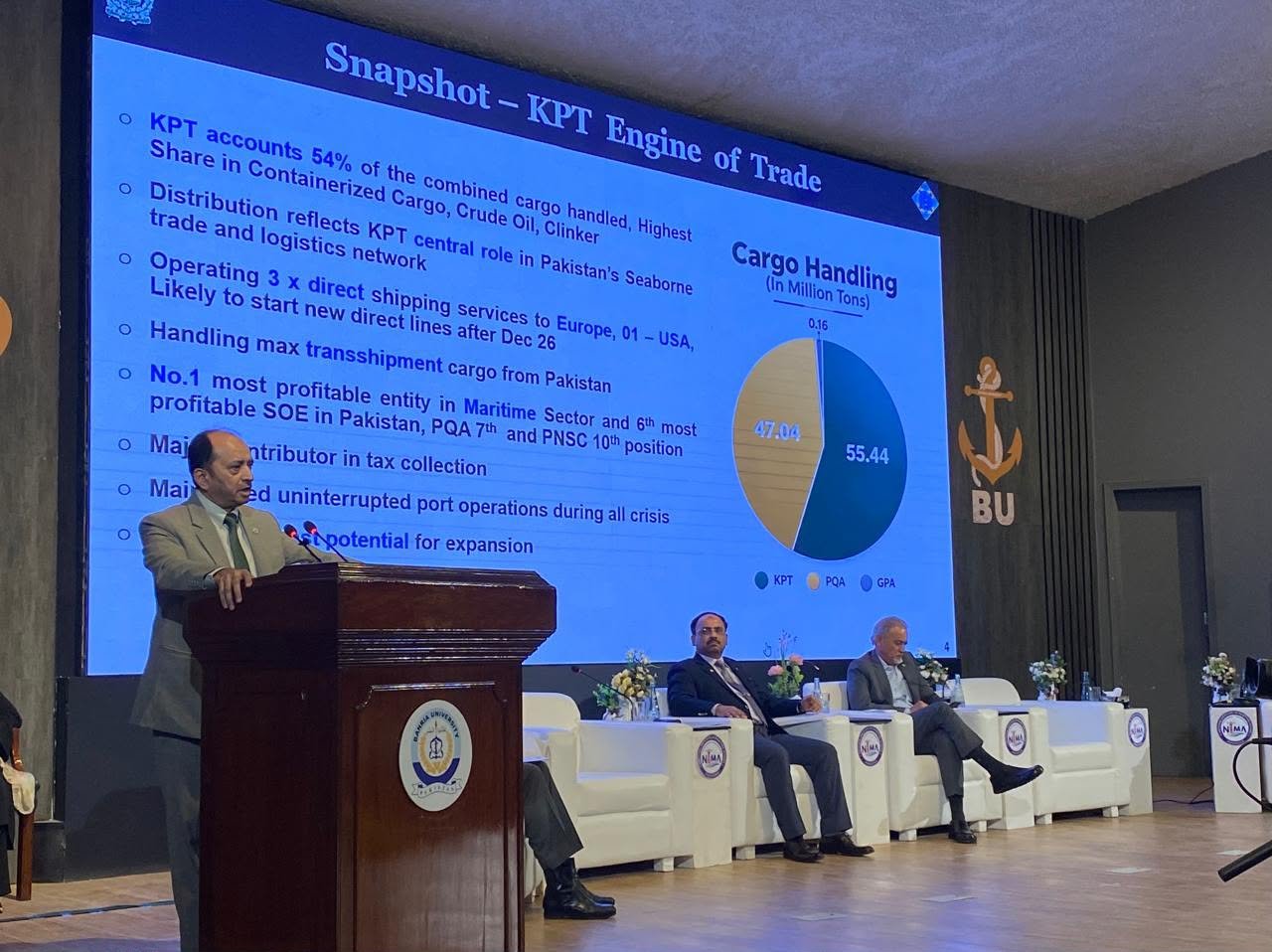
ISLAMABAD (News Desk): Karachi Port Trust (KPT) Chairman Rear Admiral Shahid Ahmed (Retd) said Karachi Port has achieved its highest-ever Port Liner Shipping Connectivity Index (PLSCI), positioning Pakistan to emerge as a major regional transit and trade hub as geopolitical tensions around the Strait of Hormuz disrupt global shipping and reshape maritime routes.
Delivering a keynote address at the International Maritime Symposium 2026 at Bahria University in Islamabad on Wednesday, the KPT chairman said shifting maritime dynamics and the eroding rules-based international order at sea have created a strategic opening for Pakistan to enhance its role in global supply chains.
The symposium was organized by the National Institute of Maritime Affairs (NIMA) and was themed “Eroding Rules-Based International Order at Sea and Maritime Security Paradigm 2.0.” The high-level forum convened senior maritime leaders, policymakers, naval strategists and experts to deliberate on emerging threats to maritime security and the future of ocean governance.
The event was held in two sessions. Session I was headlined by Chief of the Naval Staff Admiral Naveed Ashraf as chief guest, who underscored the need for a robust maritime security framework as traditional norms governing freedom of navigation face increasing challenges.
Session II, titled “Pakistan’s Maritime Future: Maritime Security, Ocean Governance and Blue Economy,” was addressed by Federal Minister for Maritime Affairs Junaid Anwar Chaudhry as chief guest. The minister said Pakistan’s ports are showing growing strength and their expanding role is critical for driving national trade and maritime growth.
In his keynote, Rear Admiral Shahid Ahmed highlighted that Karachi Port’s improved international rankings and record PLSCI score provide clear evidence of its growing integration with the world’s major shipping networks. The PLSCI, developed by the United Nations Conference on Trade and Development (UNCTAD), measures a port’s connectivity based on the number of shipping lines, vessel size, service frequency and deployment.
According to the chairman, the record index reflects enhanced shipping line calls, larger vessel capacity and improved competitiveness of Karachi Port, which handles the bulk of Pakistan’s external trade.
“With maritime routes shifting and geopolitical developments unfolding around the Strait of Hormuz, Pakistan is uniquely positioned to emerge as a secure and efficient alternative for regional transit and logistics,” the KPT chairman said.
He noted that the Strait of Hormuz, which handles nearly one-fifth of global oil shipments and a significant volume of container traffic, has become a focal point of instability amid escalating conflict in the Middle East. The resulting risk premium, rerouting of vessels and disruption to critical shipping lanes have forced global shipping lines to reassess route security and supply chain resilience.
For Pakistan, he said, this volatility presents both a challenge and an opportunity to offer regional economies, including landlocked Central Asian states, a viable gateway to international markets.
The chairman said KPT remains firmly committed to modernizing port infrastructure, deepening global connectivity and strengthening Pakistan’s position in international maritime trade. He outlined ongoing initiatives including channel deepening, cargo handling mechanization, end-to-end digitalization of port operations, reduction in vessel turnaround time and development of green port infrastructure in line with International Maritime Organization (IMO) environmental standards.
He also linked port development to Pakistan’s broader Blue Economy vision, which seeks to harness maritime resources for sustainable economic growth. He said enhanced connectivity, supported by the Special Investment Facilitation Council (SIFC) framework and targeted investment in maritime infrastructure, can transform Karachi into a hub for transshipment, value-added logistics and maritime services.
Federal Minister Junaid Anwar Chaudhry, in his address, applauded KPT’s performance under the current leadership and said the Ministry of Maritime Affairs is pursuing comprehensive reforms to improve port efficiency, attract private investment and increase Pakistan’s share in global maritime trade. He said government support for policy continuity and regulatory facilitation is yielding tangible results.
Participants at the symposium noted that Pakistan, with over 1,000 kilometers of coastline and a strategic location at the crossroads of South Asia, Central Asia and the Middle East, has historically underutilized its maritime potential, which contributes less than one percent to GDP compared to global averages. With global powers re-evaluating supply chain security, they argued, improved port performance offers a timely window to attract major shipping lines and foreign direct investment.
The International Maritime Symposium 2026 concluded with a consensus that Pakistan must invest in maritime domain awareness, ocean governance, port-led industrialization and skilled human resource development to secure its economic and strategic interests in what experts termed Maritime Security Paradigm 2.0.
Chairman KPT’s address was widely noted by participants for positioning Karachi Port not merely as the country’s premier port, but as an emerging stakeholder in the global maritime dialogue.