
KPT, KSEW join hands for indigenous ship-building
KARACHI (TKP Report): Karachi Port Trust (KPT) and Karachi Shipyard & Engineering Works (KSEW) have agreed to enhance mutual cooperation for the indigenous construction and repair of port crafts, marking a significant shift from import dependence to local shipbuilding.
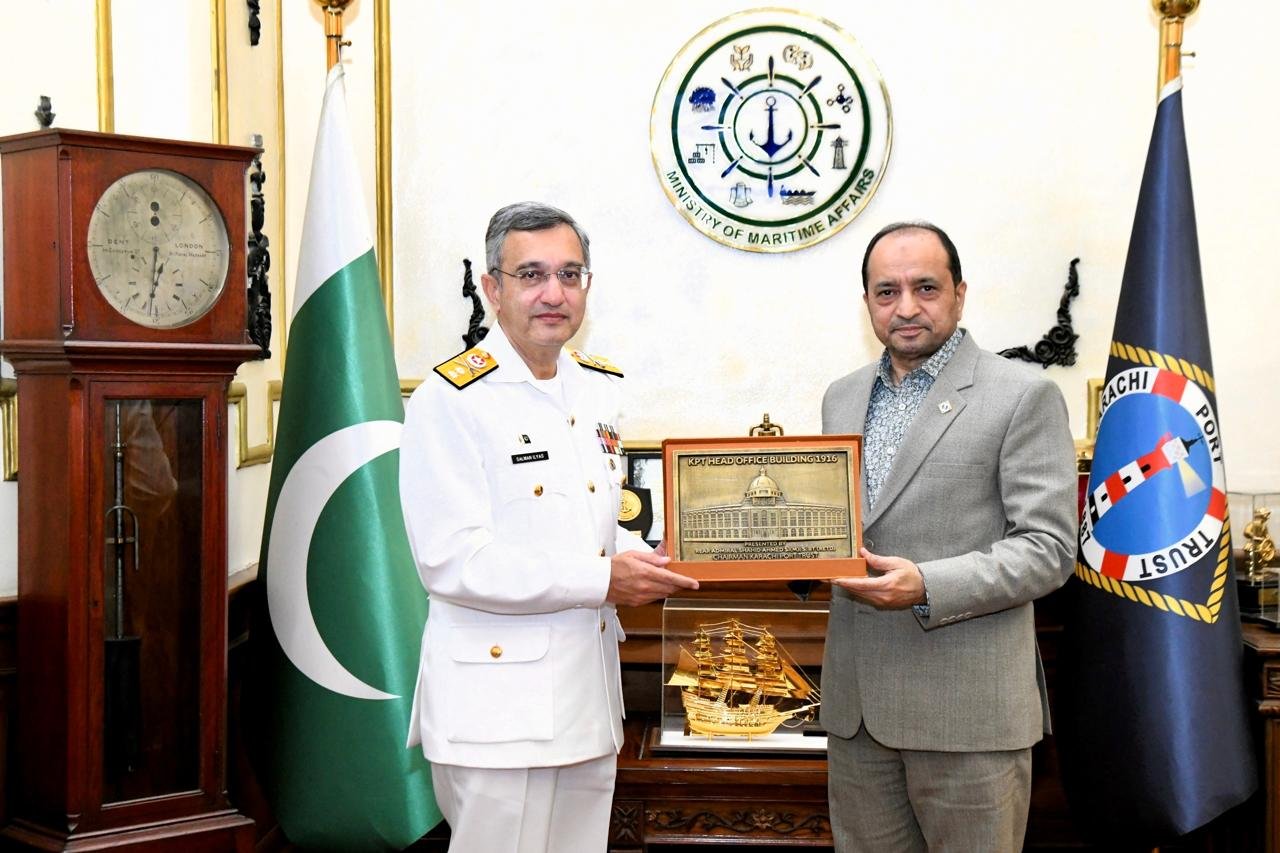
The understanding was reached during a meeting between Managing Director KSEW Rear Admiral Salman Ilyas and Chairman KPT Rear Admiral Shahid Ahmed (Retd) at KPT headquarters in Karachi.
According to KPT, the Chairman appreciated the unprecedented progress made by KSEW during the tenure of Rear Admiral Salman Ilyas and acknowledged his key role in strengthening the working relationship between the two organizations.
Both leaders reviewed the current state of cooperation and discussed a roadmap to expand collaboration, particularly in the design, construction and maintenance of KPT’s floating fleet through KSEW.
Shift Towards Indigenous Construction
During the meeting, MD KSEW assured that indigenous construction of KPT crafts at Karachi Shipyard will not only result in substantial savings of foreign exchange but will also afford numerous employment opportunities to Pakistani youth and ensure transfer of technology at an affordable cost.
Under the leadership of Rear Admiral Salman Ilyas, Karachi Shipyard & Engineering Works has continued to strengthen its shipbuilding and repair capabilities. The shipyard has an established track record of constructing MILGEM-class corvettes, fleet tankers, tugboats and commercial vessels for Pakistan’s maritime sector. It has also expanded its capacity to undertake complex naval and commercial ship-repair projects through infrastructure upgrades and modern facilities.
Sources say the collaboration between KPT and KSEW is aligned with the government’s policy of promoting self-reliance, import substitution and industrial growth under the Special Investment Facilitation Council (SIFC) framework and the Ministry of Maritime Affairs’ vision for the blue economy.
Pakistan spends hundreds of millions of dollars annually on import of vessels, crafts and related maritime equipment. Building such crafts locally will reduce import bills, retain capital within the country, and develop a skilled workforce of welders, fabricators, marine engineers and naval architects.
What are KPT Crafts?
KPT crafts are not commercial cargo ships. These are specialized vessels required for port operations to handle incoming and outgoing ships at Karachi Port, which is Pakistan’s largest and busiest port handling over 50 percent of the country’s trade.
The KPT fleet consists of harbour tugs, pilot boats, dredgers, hydrographic survey boats, mooring boats, water barges, pollution control vessels and other auxiliary crafts.
Harbour tugs are the most critical component, as they tow, push and berth giant container ships, oil tankers and bulk carriers. KPT currently operates around eight to ten tugs. Pilot boats are high-speed boats used to transport harbour pilots to ships waiting at outer anchorage, who then navigate the vessels through the narrow channel into the port.
Dredgers are essential to maintain the required depth of 12 to 14 meters in the harbour channel by removing silt and sediment from the seabed, while survey boats conduct depth measurements and channel monitoring.
In the past, these crafts were largely procured from foreign shipyards in China, Turkey and the Netherlands at a cost of millions of dollars each, putting a heavy burden on foreign exchange reserves and creating long-term dependence for spare parts and maintenance.
Economic and Strategic Impact
According to maritime experts, the local construction of port crafts will enhance the country’s industrial capacity, reduce reliance on foreign shipyards, and ensure timely availability of vessels for port operations. It will also facilitate technology transfer, as KSEW has already acquired advanced shipbuilding technologies through its collaboration with Turkey and China for naval projects.
The initiative is also expected to generate new employment opportunities and support ancillary industries such as steel fabrication, electrical systems, marine paints and machinery manufacturing in Karachi and adjoining areas.
The partnership between KPT and KSEW is being seen as a model for inter-organizational cooperation among state-owned enterprises under the Ministry of Maritime Affairs. Both organizations are key pillars of Pakistan’s maritime infrastructure, with KPT managing port operations and KSEW serving as the country’s only major shipbuilding and repair facility.
Sources said that following the top-level meeting, technical teams of both organizations will hold follow-up meetings to finalize specifications, cost estimates and timelines for construction and repair of specific crafts. Detailed proposals are expected to be prepared in the coming weeks.
The meeting concluded with both sides reiterating their commitment to further strengthen institutional ties and work jointly for promotion of Pakistan’s maritime sector, blue economy and indigenous shipbuilding capabilities, which are considered vital for national economic security and long-term growth.