
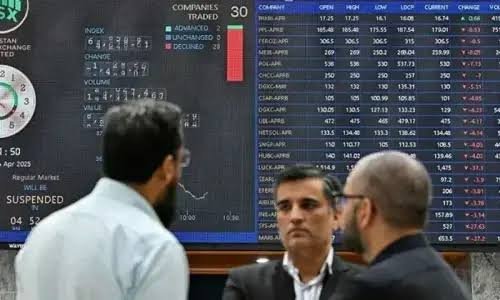
PSX shows no response to monetary policy fears
KARACHI (Staff Report): In a stark departure from its historic trend, the Pakistan Stock Exchange (PSX) showed almost no response to fears of a rate hike ahead of the State Bank of Pakistan’s monetary policy announcement today, reflecting dead volumes and shattered investor confidence.
Unlike previous monetary policy days when the market would swing wildly on rate expectations, today the market remained largely listless. The benchmark KSE-100 started the session with a nominal decline of just 40 points and later slipped by up to 1,000 points, but brokers said this was due to general prevailing negativity, not a policy-driven panic. The market’s inability to react to what is normally the biggest domestic trigger of the month has become the story itself.
Market sources said the reason for this apathy is that participation has completely dried up. Volumes which used to consistently touch 1.3 to 1.5 billion shares during active sessions have now collapsed to just 360 million shares. With such thin participation, there is simply no momentum or liquidity to react to any macro trigger, be it monetary policy or global cues.
“The market has lost its depth. Investors are not there. When you have 36 crore shares volume versus 150 crore shares, the market cannot move. People have moved to the sidelines,” a trader told The Karachi Post.
The SBP Monetary Policy Committee is going to meet today in Karachi under the chairmanship of Governor State Bank Jameel Ahmad. The meeting will review the complex geopolitical situation and domestic economic indicators before announcing the decision. Governor Jameel Ahmad will announce the new policy rate in a press conference after the meeting.
Currently, the policy rate in Pakistan stands at 11.5 percent, as confirmed by the State Bank.
According to a CFA Society Pakistan survey of market participants, there is a growing fear that the interest rate may be increased by 50 basis points due to rising global crude oil prices and persistent inflation. The hawkish expectation stems from external shocks rather than domestic demand alone.
The SBP meeting is taking place against the backdrop of the most complex phase of the Iran-US confrontation and the upcoming US mid-term elections. The combination of Middle East escalation and US political uncertainty has created unprecedented volatility in commodity and currency markets globally.
For Pakistan, the financial outlook is looking increasingly scorched by the fire of Middle East tensions. The main trigger is crude oil. Following renewed Houthi attacks on Saudi Arabia, international crude markets are in severe turmoil. Both benchmarks, Brent and US WTI, have crossed the $100 per barrel mark, a psychological barrier that has serious implications for oil-importing economies.
For Pakistan, which has just seen its goods imports hit a 51-month high in September, costlier oil will further pressure the current account deficit and put pressure on the rupee. It also directly feeds into inflation through petroleum prices.
On the domestic front, inflation remains stubbornly in double digits. According to the Pakistan Bureau of Statistics, the annual pace of inflation was recorded at 10.3 percent in September 2026, slightly lower than 11.1 percent in August 2026, but still firmly in double digits. The State Bank’s own inflation target remains at 5-7 percent, meaning real interest rates, while positive, are under threat.
This has put the State Bank in a difficult position. The business community has been vociferously demanding that the interest rate be brought down to single digits to spur industrial growth, reduce borrowing costs, and revive economic activity. The Karachi Chamber of Commerce, FPCCI, and other trade bodies argue that with industry already suffering from high energy costs, a high policy rate is choking growth.
However, Financial Expert Jibran Sarfraz argued that the SBP’s mandate is price stability first. A premature cut, or even a hold when oil is above $100, could de-anchor inflation expectations, trigger capital outflows, and put pressure on the exchange rate.
“A 50 bps hike is on the table. The SBP cannot ignore Brent at $100+. But it also cannot ignore that the market is dead and industry is crying for a cut. It is a tightrope walk,” he added.
That tightrope is clearly visible at the PSX. In normal circumstances, a potential 50 bps hike would have led to heavy selling in leveraged sectors like cements, autos, and steel, and a rally in banks. Today, there was no sectoral rotation, just a broad-based, low-volume drift downwards.