
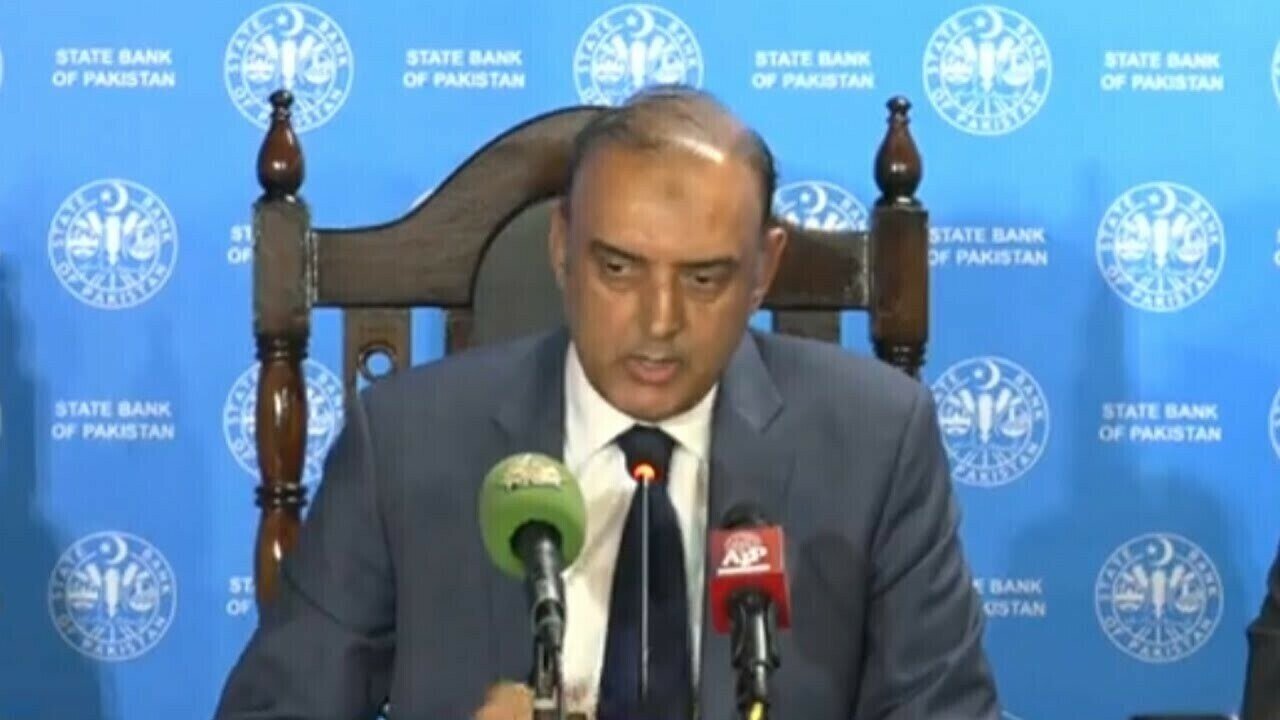
SBP hikes rate to 12%, denies interest rates stifle exports
KARACHI (Staff Report): The State Bank of Pakistan (SBP) on Monday raised its policy rate by 50 basis points to 12 percent, but Governor Jameel Ahmad rejected the argument that high borrowing costs were responsible for the stagnation in exports, pointing to concessional financing and performance-based incentives available to exporters.
The Monetary Policy Committee (MPC) increased the benchmark rate from 11.5 percent to 12 percent, with nine of its ten members voting in favour of the decision, effective October 27, 2026.
Explaining the increase, Ahmad said escalating geopolitical tensions in the Middle East, elevated international energy prices and disruptions in domestic wheat supplies had worsened the inflation outlook, prompting the central bank to tighten monetary policy.
However, the governor’s remarks on exports placed the spotlight on the relationship between monetary policy and Pakistan’s export performance, as businesses continue to face concerns over financing costs and international competitiveness.
“The stagnation in exports has no relationship with the interest rate anymore,” Ahmad said, highlighting the SBP’s Export Refinance Scheme, which provides eligible exporters with short-term financing at a concessional rate of 4.5 percent.
According to the governor, the financing limit under the scheme has been increased from Rs1 trillion to Rs1.5 trillion to facilitate exporters. He also referred to a performance-based incentive programme under which exporters achieving 10 percent growth in exports compared with the previous year qualify for a quarterly incentive of one percent.
Ahmad said the central bank remained willing to coordinate with exporters to resolve regulatory and operational obstacles affecting their businesses. He maintained that targeted financing facilities and incentives could support export growth despite the increase in the policy rate.
Pakistan’s goods exports reached $30.8 billion in the previous fiscal year and are projected to rise to between $32.5 billion and $33 billion in FY27, the governor said.
The forecast implies an increase in export earnings, although the projected growth will depend on exporters’ ability to expand overseas sales amid changing international market conditions and domestic production costs.
Meanwhile, imports are expected to rise from $70 billion to approximately $71 billion during the current fiscal year, potentially putting additional pressure on Pakistan’s external account. The projected increase in imports highlights the importance of stronger export earnings in narrowing the gap between the country’s foreign exchange inflows and outflows.
The governor projected workers’ remittances at $45 billion in FY27, up from the previous estimate of $44 billion. Remittances totalled $10.9 billion during the first quarter, supported partly by a government initiative aimed at encouraging inflows through formal channels.
Despite the expected improvement in exports and remittances, Pakistan recorded a current account deficit of $874 million in the first quarter of FY27. Ahmad attributed the pressure partly to geopolitical developments and said the full-year deficit was expected to remain between zero and one percent of gross domestic product.
Inflationary pressures remain central to the SBP’s policy stance. Headline inflation rose to 10.3 percent year-on-year in September, above expectations, while core inflation remained elevated at around 8.4 percent.
The central bank said the rate increase was intended to anchor inflation expectations, limit the secondary effects of supply shocks and bring inflation within its medium-term target range of five to seven percent.
Despite the inflation outlook and external-sector risks, the SBP retained its GDP growth forecast of 3.5 to 4.5 percent for FY27, following estimated growth of 3.7 percent in FY26. Foreign exchange reserves are projected to reach $23 billion by December 2026 and $25 billion by June 2027.
The Federation of Pakistan Chambers of Commerce and Industry (FPCCI), however, strongly denounced the rate increase, describing it as counterproductive to industrial growth.
The federation’s opposition highlights the business community’s concern that higher borrowing costs could increase production expenses, discourage investment and weaken the competitiveness of domestic manufacturers and exporters.
While the SBP maintains that concessional credit and performance-linked incentives can help address exporters’ financing needs, the broader debate over export stagnation remains significant. The effectiveness of these targeted facilities will be crucial in determining whether Pakistan can achieve its export targets while businesses operate under tighter monetary conditions.
With exports projected to rise but imports are also expected to increase, the central bank faces the challenge of containing inflation without undermining the industrial activity needed to strengthen the country’s export base.