
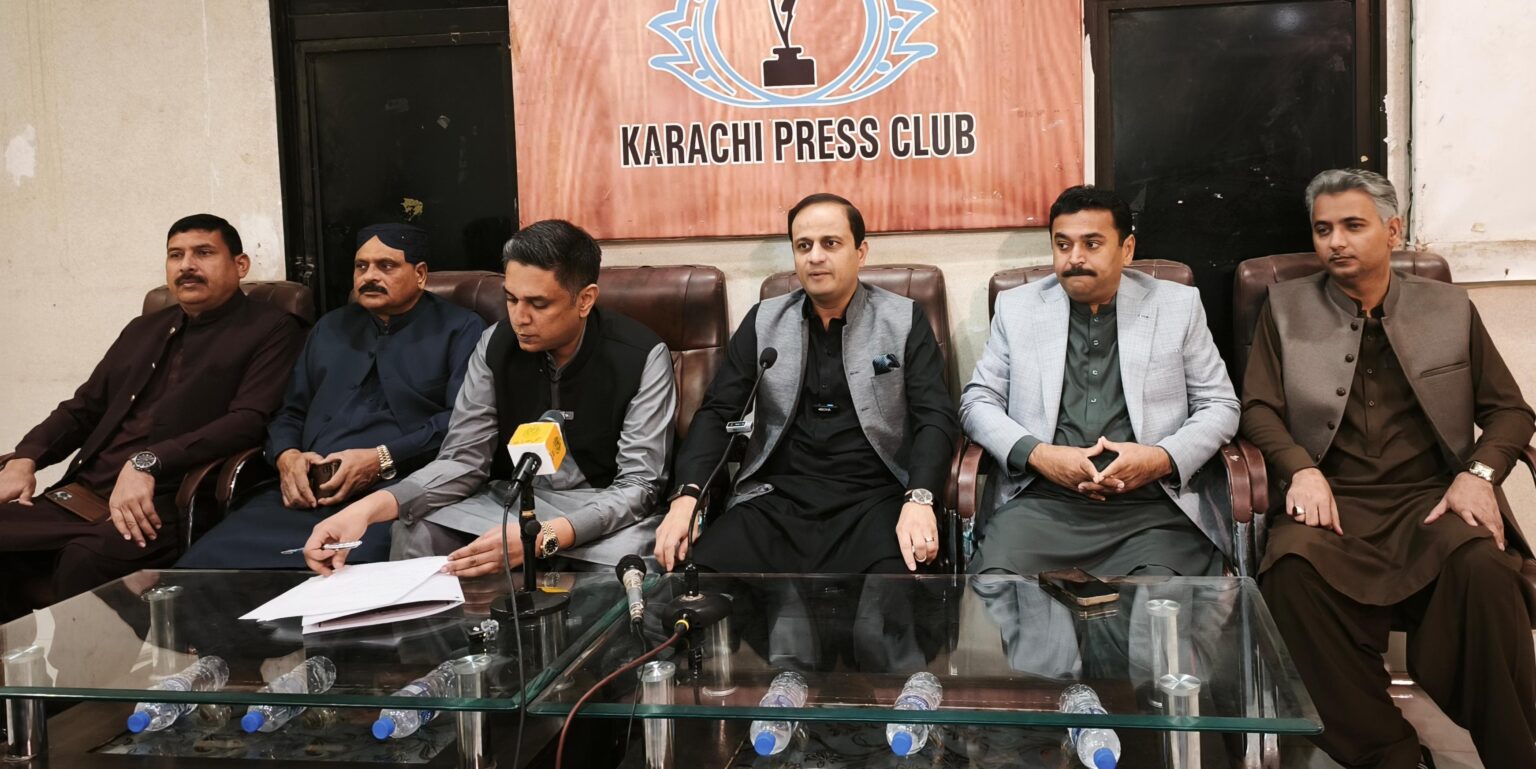
Six Sindh mayors reject new provinces, invoke constitutional process to defend territorial unity
KARACHI (Staff Report): The debate over the creation of new provinces has intensified in Sindh, with the elected mayors of the province’s six divisional headquarters jointly rejecting proposals to divide the province and insisting that any change to its geographical boundaries must follow the constitutional procedure.
Karachi Mayor Barrister Murtaza Wahab, Sukkur Mayor Barrister Arsalan Islam Sheikh, Hyderabad Mayor Kashif Shoro, Mirpurkhas Mayor Abdul Rauf Ghori, Larkana Mayor Anwar Lohar and Shaheed Benazirabad Mayor Qazi Rasheed Bhatti expressed their position at a joint press conference at the Karachi Press Club.
The gathering brought together elected representatives from all six divisional headquarters to present a united political position on Sindh’s territorial integrity, amid renewed debate over the demand for new provinces and the future of local government administration.
A central argument presented by the mayors concerned the constitutional distinction between strengthening local governments and creating new provinces.
Arsalan Islam Sheikh challenged MQM-Pakistan Convener Khalid Maqbool Siddiqui’s interpretation of Article 140-A of the Constitution, saying the provision deals with the establishment and empowerment of local government institutions and does not provide a constitutional basis for creating new provinces.
He referred instead to Article 239(4), which outlines the constitutional requirements for amending provincial boundaries. Under this provision, a constitutional amendment seeking to alter the limits of a province requires approval by at least two-thirds of the total membership of the concerned provincial assembly.
Questioning the demand for a referendum, Sheikh argued that the Constitution already provides a procedure for such changes and that a referendum cannot replace the prescribed parliamentary process.
He said attempts to misinterpret constitutional provisions to advance political demands would be challenged through legal and constitutional channels.
The position articulated by the Sukkur mayor also highlighted an important distinction in the PPP’s stated approach. He clarified that the party was not opposed in principle to the creation of new provinces but maintained that any such proposal must emerge through the relevant constitutional process and reflect the wishes of the people concerned.
This qualification places the debate beyond a simple rejection of administrative restructuring and raises questions about the constitutional authority, political consensus and public mandate required for any territorial change.
Responding to Siddiqui’s recent remarks, Sheikh also objected to statements he described as insulting to Sindh’s cultural identity. He said the province had historically welcomed people migrating from different parts of the subcontinent in 1947 and had developed as a society shaped by different languages, communities and traditions.
He described Sindh as the home of an ancient civilisation and Sufi traditions, arguing that ethnic divisions and inflammatory political rhetoric could damage relations among communities living in the province.
Karachi Mayor Murtaza Wahab said political activity should promote tolerance and coexistence rather than hostility. He argued that Karachi’s history extended well beyond 1947 and that its identity was rooted in centuries of cultural and historical development.
Wahab also recalled the violence and political tensions that affected Karachi during the 1980s and 1990s, saying the city had paid a substantial price for ethnic polarisation. Political workers, journalists and law enforcement personnel had made sacrifices to restore peace, he added.
Sheikh referred to May 12, 2007, and the Tahir Plaza tragedy as painful episodes in Karachi’s history, warning against any attempt to revive an atmosphere of fear and violence.
Hyderabad Mayor Kashif Shoro said residents of Sindh had become politically aware and expected elected representatives to demonstrate performance rather than promote ethnic divisions. He maintained that people speaking different languages continued to live together peacefully in Hyderabad.
The other three mayors also endorsed the position that Sindh’s unity, democratic values and public mandate should be protected.
The joint appearance carries political significance because it brought together municipal representatives from the province’s six major administrative divisions at a time when the debate over provincial boundaries and local government powers remains politically sensitive.
However, the constitutional question is distinct from the political arguments surrounding the demand. Article 140-A provides for elected local governments, while Article 239(4) establishes the requirement for a constitutional amendment to alter provincial boundaries. The two provisions address different aspects of governance and should not be treated as interchangeable.
The press conference concluded with the six mayors reaffirming their commitment to Sindh’s geographical integrity, constitutional supremacy, peace and inter-community harmony.
Their intervention has added a collective response from elected municipal leadership to the ongoing debate. Whether the controversy leads to a broader constitutional discussion or further political confrontation will depend on how the parties involved address the question of administrative representation, provincial authority and public consent.