
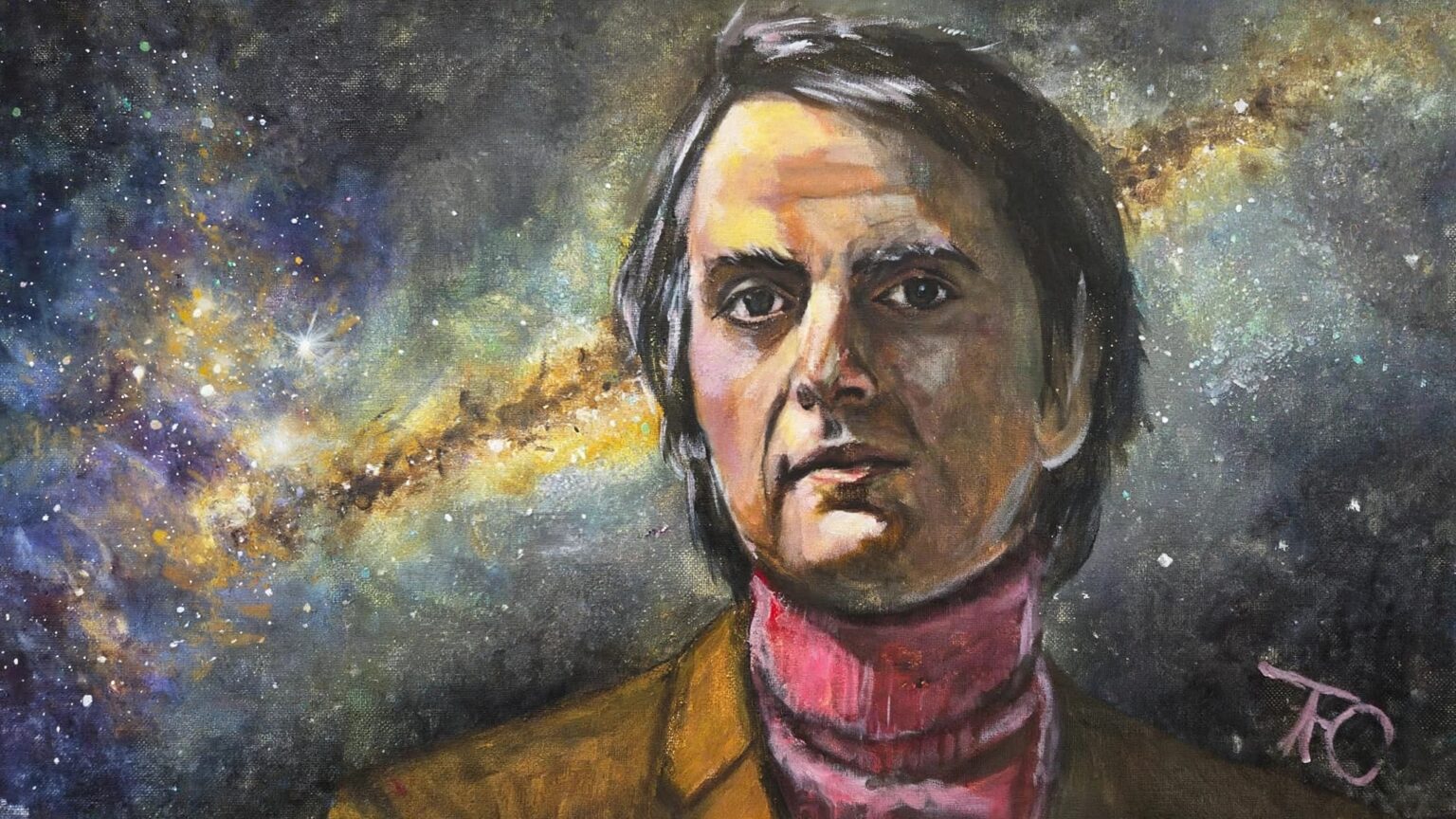
The Pale Blue Dot over Clifton Beach: Remembering Carl Sagan
KARACHI (TKP Feature): On Carl Sagan’s birth anniversary, a journey from the shores of Clifton to the farthest reaches of the universe offers Karachi a reminder that our divisions are temporary, our planet is fragile, and our responsibility towards one another is enormous.
If you stand on Clifton Beach on a relatively clear evening, you find yourself between two very different worlds. Behind you is Karachi: a sprawling metropolis of millions, restless traffic, crowded tea stalls, political arguments and the constant anxiety of people trying to make ends meet. In front of you lies the Arabian Sea, stretching towards the horizon, seemingly untouched by the noise and urgency of the city.
The contrast is striking. Karachi appears enormous when experienced from its streets, yet remarkably small when considered against the vastness of the universe.
On November 9, the world remembers the birth anniversary of American astronomer and science communicator Carl Sagan, born in Brooklyn, New York, in 1934. Had he been alive today, he would have celebrated his 92nd birthday. Sagan died in 1996, but his ideas about humanity, science and our place in the universe remain remarkably relevant.
Perhaps no idea captures his philosophy more powerfully than the Pale Blue Dot.
In February 1990, NASA’s Voyager 1 spacecraft was travelling beyond the outer planets when it was instructed to turn its camera towards Earth. From approximately six billion kilometres away, it photographed our planet as an almost invisible speck of light caught in a scattered ray of sunlight.
The photograph was extraordinary not because it showed Earth in all its beauty, but because it revealed how insignificant our home appeared against the enormous darkness of space.
Sagan had advocated taking that photograph. He later developed its philosophical meaning in his 1994 book, Pale Blue Dot: A Vision of the Human Future in Space.
His reflection was simple but profound: everything humanity has ever experienced has happened on that tiny point. Every civilization, every war, every empire, every religious tradition, every economic system, every love story and every human ambition has unfolded on the same fragile planet.
The photograph offered a perspective that no political speech, philosophical argument or economic theory could communicate quite as effectively.
And perhaps Karachi needs that perspective today.
A city consumed by its immediate problems
Karachi is a city where everyday life can become an exhausting exercise in survival. Rising living costs, unreliable public services, deteriorating infrastructure, political disagreements, environmental degradation and questions about public safety dominate conversations.
People are often so consumed by immediate challenges that there is little room to consider anything beyond the next electricity bill, the next salary, the next journey through traffic or the next political controversy.
There is nothing insignificant about these struggles. For a family struggling with inflation, economic hardship is not an abstract concept. For a commuter spending hours on damaged roads, infrastructure is not merely a policy discussion. These are real problems that demand practical solutions.
But Sagan’s philosophy invites us to consider another dimension of our existence.
What happens when we step back and examine the things that divide us?
The neighbourhood rivalries, political loyalties, ethnic disagreements and social distinctions that sometimes dominate Karachi’s public life begin to look different when viewed against the scale of the universe.
From millions of kilometres away, there are no political constituencies, no neighbourhood boundaries and no distinctions between the wealthy and the poor. There is simply one planet, shared by everyone.
This does not mean our differences are unimportant or that injustice should be ignored. Rather, it reminds us that disagreement should never erase our shared humanity.
The fragility of our only home
There is another reason why the Pale Blue Dot should resonate with Karachi: the vulnerability of the city itself.
Karachi’s relationship with the Arabian Sea is central to its identity and economic importance. Its coastline supports maritime commerce, fishing communities, recreational activity and livelihoods. Yet the same coastal geography exposes the city to environmental risks.
Climate change, rising sea levels, coastal erosion, extreme weather and flooding are challenges that cannot be addressed through political divisions or short-term thinking.
The World Bank has identified coastal cities such as Karachi as vulnerable to climate-related sea-level rise, cyclones, saltwater intrusion and coastal erosion.
Standing at Sea View, the ocean can appear endless and invincible. But the relationship between human settlements and the natural environment is far more delicate than appearances suggest.
The sea does not recognize administrative boundaries. Climate risks do not distinguish between political supporters and opponents. Environmental damage does not ask about a person’s income before affecting their neighbourhood.
In this sense, Sagan’s message becomes more than a philosophical reflection. It becomes a reminder of collective responsibility.
We have only one known home. Protecting it requires scientific understanding, responsible governance, public awareness and cooperation across communities.
Looking beyond ourselves
Sagan was not merely an astronomer who studied distant planets. He was also a gifted communicator who believed scientific knowledge should be accessible to ordinary people.
His celebrated television series Cosmos: A Personal Voyage introduced millions of viewers to the wonders of the universe. He helped explain complicated scientific ideas through language that encouraged curiosity rather than intimidation. His career also involved contributions to NASA’s planetary exploration missions.
His legacy offers another lesson for Karachi, a city with immense intellectual potential but a public conversation frequently dominated by immediate controversies.
Science, education, curiosity and critical thinking deserve a greater place in our everyday discussions. A society that learns to ask questions about the universe may also become more willing to question its own assumptions.
Perhaps that is what a cosmic perspective ultimately offers: not an escape from reality, but a better understanding of it.
We do not need to travel six billion kilometres to experience the feeling Sagan described. Sometimes, looking at the night sky from a Karachi rooftop or watching the waves at Clifton Beach is enough to remind us that our individual lives are part of something much larger.
The view from Clifton
As evening settles over Sea View, the city continues its familiar rhythm. Motorcycles move through crowded roads, vendors serve tea, families walk along the shoreline and the lights of Karachi gradually emerge against the darkening sky.
Life goes on, with all its complications and contradictions. Somewhere beyond that sky, Earth continues its journey around the Sun, carrying billions of people who may never agree on politics, religion, economics or the future of their societies. Yet they share the same atmosphere, the same oceans and the same uncertain future.
On his birth anniversary, Carl Sagan’s Pale Blue Dot offers Karachi a thought worth remembering: our problems are real, but so is our shared responsibility towards one another.
Perhaps the greatest lesson of looking at Earth from space is not that human beings are insignificant. It is that, despite our differences, we are all here together.
And there is nowhere else, at least as far as we know, to go.
When seen from the outer space Our planet is really a speck. Inspire of devastating wars since the inception of civilization humanity have been a collection of catastrophies and better living……eradication of deadly microbes to agricultural food production.