
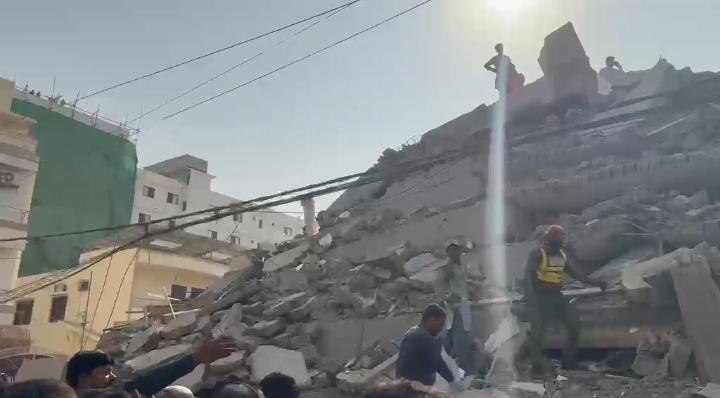
Three notices, no action: Karachi building collapse exposes regulatory failure
KARACHI (Staff Report): The collapse of a multi-storey under-construction building in Karachi’s Admin Society has raised serious questions about regulatory oversight and the enforcement of building laws after documents reportedly showed that the construction had continued despite multiple notices issued by local authorities.
The building, located at plot C-163, Block 4, Karachi Administration Employees Cooperative Housing Society, near Baloch Colony and Shahrah-e-Faisal, was reportedly approved for ground-plus-one-floor construction. However, the structure had reached ground-plus-six floors, with work on a seventh-floor penthouse reportedly underway before it suddenly collapsed on Wednesday afternoon.
According to information shared by the local Union Committee administration, notices were issued to Muhammad Abdullah Shakeel and Bilal Shakeel on April 24, 2026, over allegedly unauthorized construction. A second notice was reportedly issued on the same date, followed by a final notice on May 6.
Copies of the notices were also sent to the Director General of the Sindh Building Control Authority (SBCA), Deputy Commissioner East, Assistant Commissioner Ferozabad, Director Land of Chinisar Town and the SHO of Tipu Sultan police station.
Despite these communications, construction reportedly continued, raising questions about why the relevant authorities failed to take effective enforcement measures before the incident.
The SBCA has reportedly stated that the property was originally a residential plot where only ground-plus-two construction was permissible, but it was converted into a commercial building with additional floors. Meanwhile, the building approval plan reportedly indicated permission for only ground-plus-one construction. The discrepancy between these accounts requires clarification from the regulator.
Rescue sources initially estimated that more than 40 workers, including labourers and painters, were present when the structure collapsed at around 1:30pm. Between 20 and 25 people were initially feared trapped beneath the debris, while four injured workers were reported to have been rescued in the early stages of the operation.
The building reportedly housed workers carrying out finishing work. One worker said the structure shook for a few seconds before coming down. Several vehicles parked in the adjoining street were also buried under the rubble.
Police identified Zeeshan Aslam as the building’s owner and Badshah Khan as its contractor. Police, Rangers, Rescue 1122 and other emergency services reached the site to assist in rescue operations.
Sindh Chief Minister Syed Murad Ali Shah took notice of the incident, directing relevant departments to accelerate rescue efforts, arrange medical assistance and inspect neighbouring buildings for potential safety risks. He also instructed the SBCA to examine the approved building plan, construction standards and possible negligence.
Sindh Home Minister Zia-ul-Hassan Lanjar sought a detailed report from the DIG East and called for an impartial investigation to establish the causes of the collapse and identify those responsible.
The incident also places the enforcement of Karachi’s building regulations under renewed scrutiny. The central question is not merely whether unauthorized floors were constructed, but why repeated official warnings failed to stop work at the site.
If the alleged violations and prior notices are established, the investigation will need to determine whether the failure lay in inadequate monitoring, weak enforcement or deliberate negligence by officials and private parties.
For Karachi, where unauthorized construction and building safety remain persistent urban governance concerns, the tragedy could become a test of whether regulatory authorities can move beyond issuing notices to ensuring compliance and accountability.