
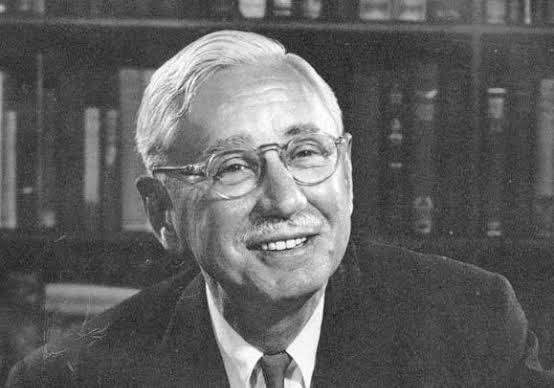
Will Durant, Donald Trump and lessons humanity still refuses to learn
KARACHI (TKP Feature): As the world navigates geopolitical rivalries, rising nationalism, economic inequality and increasingly polarized politics, the writings of American historian and philosopher Will Durant offer a timely reminder that technological advancement does not necessarily translate into human progress.
Born on November 5, 1885, in North Adams, Massachusetts, Durant would have turned 141 today. More than four decades after his death in 1981, his observations about power, wealth, war, politics and civilisation remain relevant to a world that appears technologically transformed but continues to struggle with many of the same questions that confronted earlier generations.
Perhaps no contemporary political figure provides a more interesting subject for examining Durant’s historical observations than US President Donald Trump.
Durant devoted much of his intellectual life to understanding why civilisations rise, flourish and eventually decline. Through his monumental eleven-volume work, The Story of Civilization, written alongside his wife Ariel Durant, he attempted to connect politics, economics, religion, philosophy, science and culture into a broader understanding of human society.
The couple’s intellectual undertaking spanned four decades, from the publication of Our Oriental Heritage in 1935 to The Age of Napoleon in 1975. Their contribution received the Pulitzer Prize in 1968 and the Presidential Medal of Freedom in 1977.
However, it was their shorter work, The Lessons of History, published in 1968, that offered a particularly concentrated examination of the recurring patterns of human civilization.
The book explored how political institutions, economic arrangements, geography, religion and human ambitions influence the direction of societies. Its central proposition remains uncomfortable: humanity may accumulate knowledge across generations, but its fundamental struggles are remarkably persistent.
This is where Durant’s work becomes particularly interesting in the context of Trump and contemporary American politics.
Trump’s political philosophy, built around the slogan ‘Make America Great Again’, places national sovereignty, economic protectionism, border security and American interests at the centre of his administration’s agenda. His second presidency, which began in January 2025, has continued to advance an explicitly America First approach to domestic and foreign policy.
Supporters view this approach as an attempt to restore American economic strength and national confidence, while critics question its implications for international cooperation, immigration and the established global order.
Durant’s historical perspective offers a way to examine these developments beyond the immediate political debate.
History is filled with powerful nations that sought to protect their economic interests, expand their influence and preserve their dominant positions. National ambition has frequently contributed to political consolidation and economic expansion, but it has also generated competition, conflict and instability.
The question Durant’s work encourages us to ask is whether national greatness can be sustained through economic and military power alone, or whether it also depends on institutions, education, social cohesion and intellectual openness.
Trump’s emphasis on tariffs, manufacturing and economic nationalism also invites a broader examination of the relationship between wealth and power. Throughout history, commercial expansion has strengthened states, financed armies and transformed societies. Yet economic prosperity has not automatically guaranteed political stability or social equality.
Another important dimension is the relationship between leadership and democratic institutions.
Durant’s historical writing repeatedly examined the concentration of power and the changing relationship between individuals and political systems. The rise of influential leaders has often reflected deeper public frustrations, institutional weaknesses and demands for political change.
Trump’s political success, including his return to the White House after losing the 2020 election, demonstrates the enduring influence of populist mobilization and political personalities in modern democracies. It also raises questions about the resilience of democratic institutions and the balance between executive authority and institutional accountability.
These questions are not exclusive to the United States. Democracies across the world continue to confront tensions between popular mandates, institutional independence, national identity and political polarisation.
For countries such as Pakistan, Durant’s observations carry another significance. Political instability, economic inequality, institutional weaknesses and the concentration of influence remain recurring challenges in developing societies. Studying the experiences of earlier civilisations can help explain why economic resources alone cannot guarantee sustainable national development.
Durant also offers an important lesson about the relationship between knowledge and progress. The modern world possesses artificial intelligence, advanced scientific research, unprecedented communication networks and technological capabilities unimaginable to previous generations. Yet wars, ideological divisions and struggles over resources continue.
The distinction between what humanity can achieve technologically and what it can accomplish morally remains one of the defining questions of our time.
Ultimately, Durant’s intellectual legacy was not simply about recording the achievements of great rulers, empires and philosophers. It was about understanding the broader forces that shape human civilisation.
His collaboration with Ariel Durant sought to make that understanding accessible beyond universities and academic institutions, bringing the study of history and philosophy to ordinary readers.
On his 141st birth anniversary, the relevance of Will Durant lies in a simple but enduring challenge: to examine the present through the experience of the past.
Donald Trump may represent a distinctly contemporary political phenomenon, but the questions surrounding nationalism, leadership, wealth, power and civilization are centuries old.
The world has changed dramatically since Durant’s birth in 1885. Whether human beings have learned enough from their history to change their behaviour is a question that remains unanswered.