
Pakistan seeks South African investment in critical minerals, mining and value addition
ISLAMABAD (Staff Report): Pakistan is seeking to attract South African investment and technical expertise into its mining, critical minerals and mineral-processing industries as the government looks to strengthen bilateral economic relations and expand cooperation beyond conventional trade.
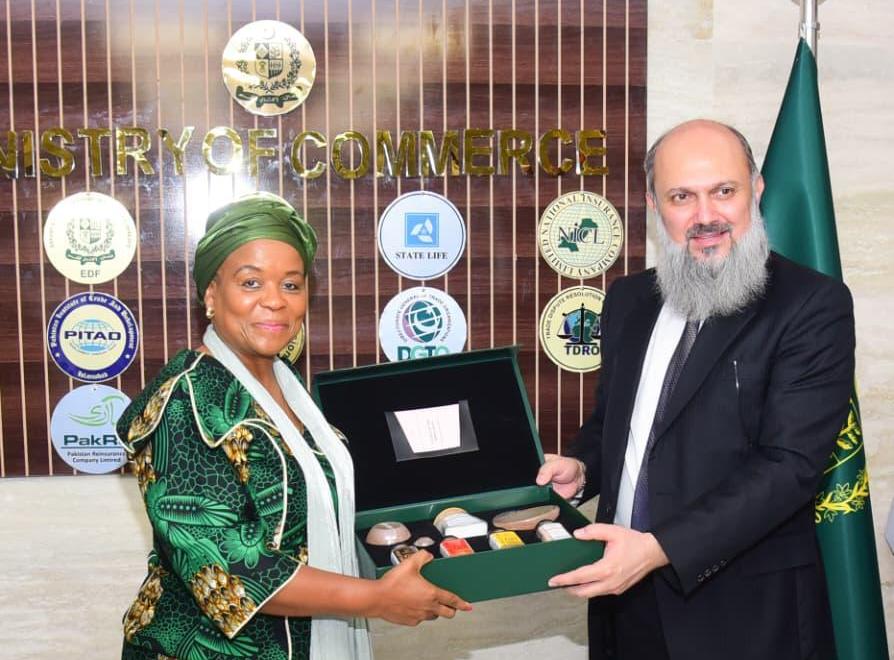
The initiative was discussed during a meeting between Federal Minister for Commerce Jam Kamal Khan and a high-level South African business delegation led by Dr. Gwen Malegwala Ramokgopa, Treasurer General of the African National Congress and Group Chair of the Progressive Business Forum (PBF), at the Ministry of Commerce in Islamabad.
The discussions highlighted opportunities for joint ventures, industrial investment and business-to-business cooperation, with particular emphasis on mining, mineral processing, gemstone cutting and polishing, and jewellery manufacturing.
Commerce Minister Jam Kamal Khan invited South African investors to explore Pakistan’s mining and critical minerals sector, identifying mineral development and downstream processing as potential areas for mutually beneficial economic partnerships.
The emphasis on value addition is particularly significant for Pakistan, where developing domestic mineral-processing capabilities could create opportunities beyond the extraction and export of raw materials. Investment in processing facilities, gemstone cutting, polishing and jewellery manufacturing could help generate industrial activity, employment and export-oriented production.
South Africa, with its established mining industry and experience in mineral-related businesses, could potentially offer technical expertise, investment partnerships and opportunities for knowledge exchange. However, translating this potential into commercial projects would require concrete investment proposals, commercially viable arrangements and effective regulatory facilitation.
The two sides also discussed expanding cooperation in agriculture, information technology, dairy, livestock and halal products, reflecting an effort to diversify bilateral trade across multiple sectors.
The minister highlighted Pakistan’s growing IT industry and skilled young workforce as potential areas for collaboration, while encouraging stronger engagement between the business communities and chambers of commerce of both countries to identify trade barriers and explore new commercial opportunities.
He also briefed the South African delegation on investment facilitation measures introduced through the Special Investment Facilitation Council (SIFC), as well as the role of the EXIM Bank of Pakistan in supporting export-oriented businesses, particularly small and medium-sized enterprises.
For Pakistan, stronger commercial engagement with South Africa could provide opportunities to diversify export destinations and develop business connections with a major African economy. Greater institutional cooperation between chambers and private-sector organisations could help businesses identify market requirements, establish distribution networks and explore joint ventures.
Dr. Ramokgopa acknowledged the longstanding relationship between the two countries and stressed the importance of translating historical ties into practical economic partnerships. She highlighted opportunities in mining, local value addition, research, innovation and institutional investment.
She also encouraged Pakistani businesses to participate in South African investment forums, including Mining Indaba, which could provide a platform for Pakistani companies to engage with international mining investors and industry stakeholders.
Beyond mining and industrial cooperation, discussions covered academic exchanges, university-industry collaboration and tourism. Both sides also considered improved air connectivity and more cost-effective shipping arrangements to facilitate trade and business travel.
Logistics will remain an important consideration in expanding bilateral commerce. Competitive shipping costs, reliable trade routes and improved connectivity are essential for making exports commercially viable and encouraging regular business transactions between geographically distant markets.
The South African delegation’s engagements with Pakistani manufacturers and educational institutions in Karachi, Lahore and Islamabad also provided opportunities to explore commercial and institutional partnerships.
Nevertheless, the real test of the renewed engagement will be whether discussions translate into investment commitments, joint ventures, increased trade volumes and concrete projects.
For Pakistan, the opportunity extends beyond attracting foreign investment into mining. Developing local processing capabilities, strengthening industrial linkages and expanding access to African markets could support a broader export-diversification strategy.
The meeting has opened another channel for economic cooperation between the two countries. Converting that diplomatic engagement into measurable commercial outcomes will now depend on sustained private-sector participation, investment facilitation and the removal of practical barriers to trade.