
AJK’s Rs14.75 bn development plan faces 100-day delivery test
MUZAFFARABAD (Agencies): The newly elected government of Azad Jammu and Kashmir (AJK) has unveiled a Rs14.75 billion development programme for its first 100 days, setting an ambitious agenda for improvements in healthcare, education, transport, tourism, housing and youth employment, while Prime Minister Shehbaz Sharif has assured federal support to help implement the proposed projects.
The programme now faces a critical implementation test, with federal and AJK leadership emphasizing that development initiatives must translate into completed projects and tangible public benefits rather than remain limited to announcements.
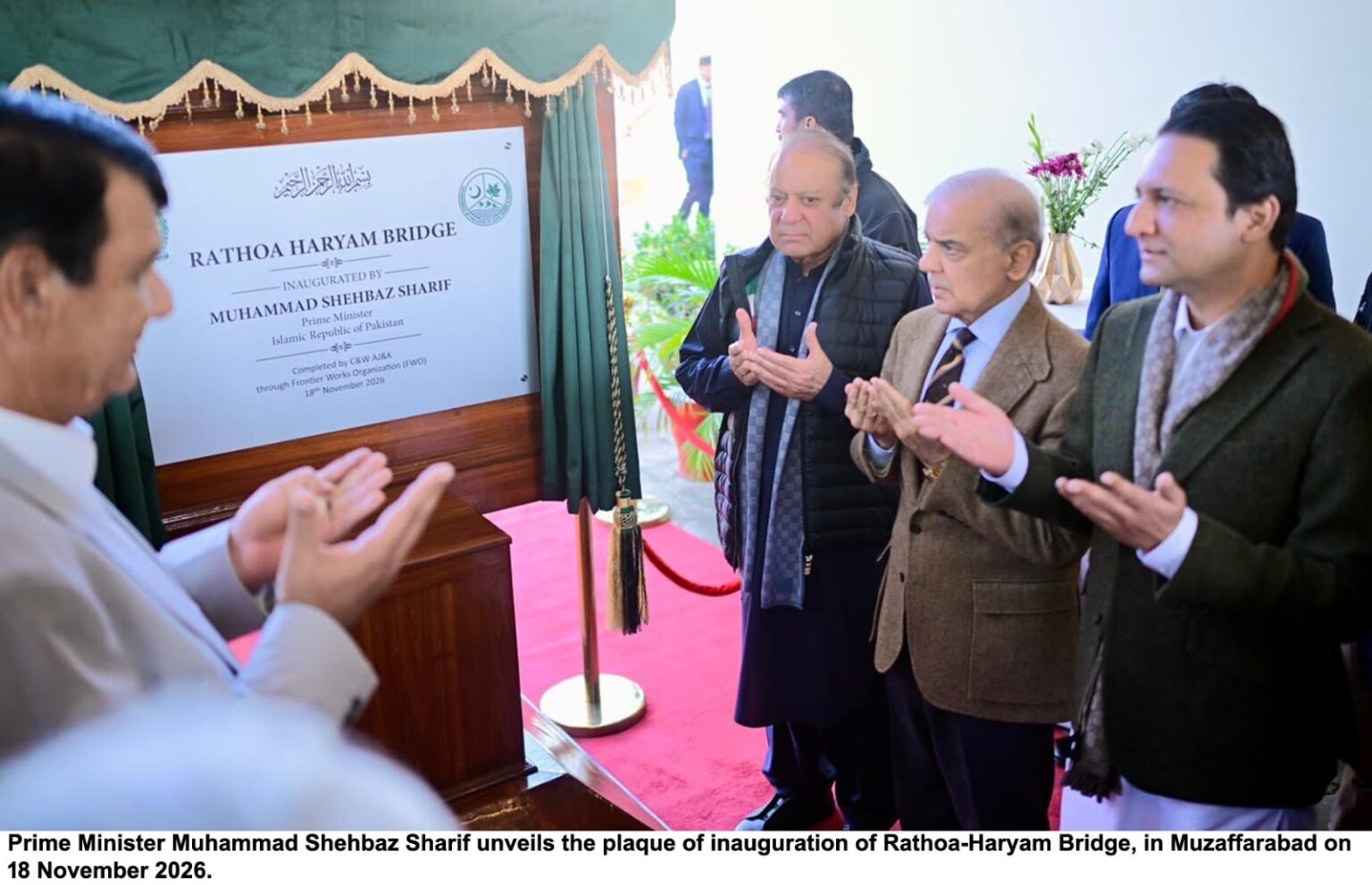
Addressing a meeting on the 100-day development plan in Muzaffarabad on Wednesday, Prime Minister Shehbaz Sharif said the federal government would provide maximum possible financial resources for AJK’s development and extend full cooperation to the state government.
He stressed that public welfare projects must be implemented with transparency, efficiency and clearly defined completion timelines, arguing that the real value of development initiatives lies in their completion and the benefits delivered to citizens.
The AJK government, led by Prime Minister Syed Iftikhar Ali Gillani, presented details of the Rs14.75 billion programme, covering several sectors considered essential for improving public services and economic activity across the region.
The healthcare component includes the establishment of three cardiac catheterisation laboratories and two stroke centres, alongside the upgrading of Basic Health Units (BHUs). The government also plans to introduce a Clinic on Wheels service based on the Punjab model within the first 100 days.
In urban services, the programme includes the expansion of the Green Bus service to six additional cities. The service has already been launched in Muzaffarabad and Mirpur, while supporting infrastructure in the three cities selected for expansion is also targeted for completion during the programme period.
The government has also announced the launch of the Apni Chhat, Apna Ghar housing scheme during the first 100 days, alongside the introduction of the Suthra Kashmir initiative in all eight district headquarters. Work on the cleanliness programme is expected to begin in less than a month.
Tourism development is another major component, with government-operated tourist guesthouses scheduled for modernisation within six months. Beautification projects in Muzaffarabad and other divisional headquarters are targeted for completion within three months, while improved road access and infrastructure at important tourist destinations are also included in the development agenda.
Education and youth development have received separate attention. The AJK government plans to introduce two scholarship schemes within the first 100 days, one for students enrolled in public universities and another for deserving students seeking higher education at leading private universities.
A skills development programme for young people is also planned, alongside financial assistance through loans for those seeking to establish their own businesses.
Education infrastructure is expected to receive additional federal support. Shehbaz Sharif announced that a Daanish School in Bhimber would be inaugurated next month, while construction of a Daanish University campus in Muzaffarabad was also underway.
He said the schools would include artificial intelligence and information technology laboratories and provide education through qualified teachers. Similar institutions are being developed in other parts of AJK.
The Prime Minister also announced plans to establish an Asaan Khidmat Centre in AJK, following the model introduced in Islamabad. The proposed facility would bring services relating to national identity cards, police, healthcare and other public matters under one roof.
Meanwhile, Nawaz Sharif, who also addressed the meeting, called for prioritizing the proposed Muzaffarabad-Mirpur motorway, describing connectivity as an important driver of regional development and tourism.
He referred to earlier plans under the China-Pakistan Economic Corridor (CPEC) framework and said the motorway could open up the interior areas of AJK to greater economic activity and tourism.
He also urged the federal government to accelerate the remaining section of the Sukkur-Hyderabad motorway, highlighting the importance of completing major transport links.
Nawaz Sharif said federal and state governments were now working together on AJK’s development and stressed that the time had come to translate commitments into practical results.
A key governance issue emerged during the meeting when Punjab Chief Minister Maryam Nawaz emphasized that launching projects alone would not be sufficient without effective monitoring and continuous public-service delivery.
She proposed a system through which citizens could directly communicate their complaints and problems to the AJK prime minister and receive responses within 24 hours.
She said public services, including hospitals, transport and police assistance, required round-the-clock monitoring to ensure that facilities remained functional and accessible.
Maryam Nawaz also offered Punjab’s administrative and technological experience to support AJK’s development programmes. She highlighted the role of the Punjab Information Technology Board in monitoring government projects, tracking beneficiaries and assessing implementation progress.
She said Punjab had provided IT training to 500,000 people over the past two and a half years, with many obtaining employment opportunities abroad. She suggested that similar skills development initiatives could help young people in AJK access domestic and international employment markets.
The AJK prime minister said the 100-day programme was designed to restore public confidence in government institutions following a period of political instability, during which four governments changed over five years.
He said the administration wanted citizens to assess its performance through visible improvements in public services and the completion of development projects.
The programme’s success, however, will depend on the availability and timely release of financial resources, coordination between federal and state authorities, transparent procurement and the ability of departments to complete projects within the announced deadlines.
While the Rs14.75 billion allocation represents an ambitious development agenda, the announcements also create measurable expectations for the new administration.
The next 100 days will therefore serve as an early test of whether the federal and AJK governments can convert their development commitments into functioning healthcare facilities, expanded public transport, improved urban services, educational opportunities and employment initiatives.
For AJK residents, the ultimate measure of the programme will not be the number of projects announced but whether these initiatives produce visible improvements in everyday life.