
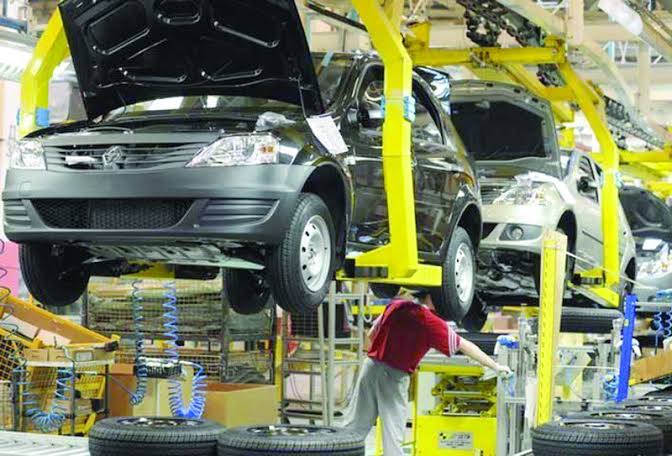
Pakistan targets $6 bn auto exports, $17.7 bn forex savings via localization
ISLAMABAD (Staff Report): Pakistan has set a cumulative automotive export target of $6 billion over the next five years and projected foreign exchange savings of $17.7 billion under its new Auto and Auto Parts Manufacturing Policy 2026–2031, as the government seeks to transform the automobile industry from an import-dependent assembly model into an export-oriented manufacturing sector.
The new policy makes localisation, domestic value addition and export performance central to the automotive industry’s future, linking import incentives with local manufacturing commitments and minimum localisation requirements.
Prime Minister’s Adviser on Industries and Production Haroon Akhtar Khan said the policy reflects the government’s vision of developing an export-led, self-reliant and competitive economy by strengthening domestic manufacturers, expanding local auto parts production and integrating Pakistani companies into global automotive supply chains.
He said the government’s objective was not merely to facilitate vehicle assembly or provide tariff protection, but to establish a sustainable industrial framework in which local vehicle and auto parts manufacturers could expand production, adopt modern technologies and compete in international markets.
Under the policy, the government expects cumulative automotive exports of approximately $6 billion between 2026 and 2031, with auto parts manufacturers accounting for around $3.29 billion, or 55% of the target, while vehicle manufacturers are expected to contribute approximately $2.72 billion, representing 45%.
The export targets place significant emphasis on the domestic auto parts industry, which the government considers essential for developing a competitive manufacturing base and securing a stronger position in international automotive supply chains.
The policy also projects foreign exchange savings of approximately $17.7 billion over five years through increased local production and value addition, compared with the foreign exchange requirements associated with importing equivalent vehicles in completely built-up (CBU) form.
Haroon Akhtar Khan said greater localisation would reduce dependence on imported vehicles and components, ease pressure on the country’s external accounts and strengthen industrial self-reliance.
A key feature of the new framework is the introduction of mandatory localisation requirements, under which automotive manufacturers will be required to progressively increase domestic value addition.
Under the proposed mechanism, failure to meet prescribed minimum localisation requirements could result in an additional three percentage points in customs duty on relevant non-locally manufactured completely knocked-down (CKD) imports in the following financial year, subject to the applicable legal procedure.
The policy also seeks to gradually rationalise customs duties over its five-year implementation period, while ensuring that import-related concessions remain linked to domestic manufacturing, localisation and export obligations.
The government believes this approach will encourage automobile manufacturers to shift towards greater domestic sourcing and create stronger linkages between vehicle assemblers and local component manufacturers.
Pakistan currently has approximately 2,200 auto parts manufacturers, whose technological capabilities and production standards will be important for achieving the policy’s localisation and export objectives.
To support the domestic vendor industry, the government has allocated Rs2.1 billion for the Vendor Upgradation and Technology Transfer Programme, which will be implemented through the Engineering Development Board (EDB) and Small and Medium Enterprises Development Authority (SMEDA).
The programme will support local manufacturers in acquiring modern technologies, accessing shared production facilities, improving workforce skills, obtaining international certifications and preparing for export markets.
The policy also targets investment in at least five major auto parts manufacturing companies during its implementation period.
For export promotion, the government has introduced a Drawback of Local Taxes and Levies (DLTL) scheme, offering eligible exporters support equivalent to 5% of net free-on-board export value, with an additional 10% incentive for incremental exports, subject to prescribed conditions.
Manufacturers will also be required to pursue export opportunities through the global supply chains of their international partners.
The policy further seeks to mobilise underutilised industrial capacity through contract manufacturing arrangements. According to the government, industrial capacity utilisation in various sectors currently leaves between 41% and 80% of production capacity unused.
The government expects better utilisation of existing industrial infrastructure to encourage fresh investment, expand manufacturing activity and generate employment opportunities.
While the policy sets ambitious targets for exports and foreign exchange savings, its implementation will depend on manufacturers’ ability to meet localisation requirements, improve product quality, control production costs and compete with established international suppliers.
The availability of modern technology, reliable industrial infrastructure and a competitive business environment will also remain important factors in determining whether Pakistan’s automotive sector can move beyond domestic assembly towards sustained export-oriented manufacturing.
The new policy therefore represents an attempt to link the expansion of the domestic automobile market with industrial development, export growth and reduced dependence on imported vehicles and components.