
US-China AI chip war, Middle East tensions weigh on PSX
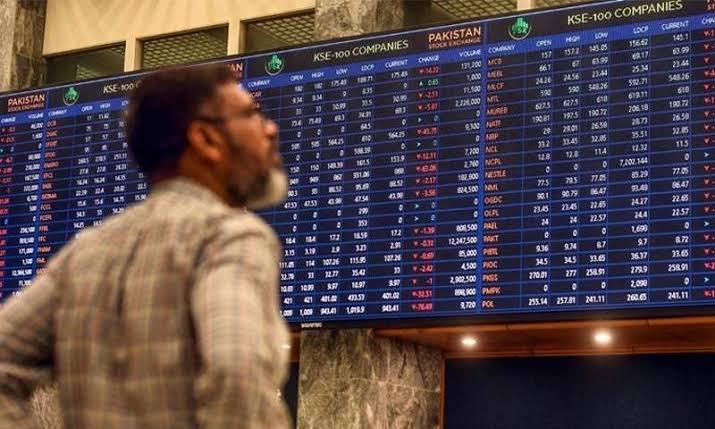
KARACHI (TKP Report): Escalating technology tensions between the United States and China, continuing instability in the Middle East and domestic political uncertainty are adding to the challenges facing Pakistan’s equity market, as the benchmark KSE-100 index fell 1,223 points on Wednesday.
The latest decline reflects growing investor caution amid an uncertain international environment. Pakistan Stock Exchange (PSX) Chief Executive Officer Farrukh Sabzwari in his meeting with PSX reporters has also highlighted the influence of international developments on market performance, particularly the evolving situation in the Middle East, indicating that global events remain an important factor shaping investor sentiment.
The US-China technology rivalry has emerged as another source of uncertainty for international markets. Washington has tightened restrictions on China’s access to advanced artificial intelligence chips, raising concerns about the future of technology trade between the world’s two largest economies.
The dispute has implications beyond the semiconductor industry. Advanced chips are central to the expansion of artificial intelligence, data centres and cloud computing, making restrictions on their supply a concern for technology companies, investors and global supply chains.
The latest development came on Wednesday when Nvidia said it had stopped shipping US-licensed Hopper-generation data-centre chips to China and had no further shipments included in its current outlook. The development has raised fresh questions about the future of chip trade between Washington and Beijing. Reuters reported that the company had previously sold $2.4 billion worth of licensed Hopper products to China in the quarter ended October 25.
The technology dispute has also affected investor sentiment in international markets. However, its direct contribution to Wednesday’s decline at the Pakistan Stock Exchange has not been established. Asian markets were mixed, with some technology shares recovering after Nvidia reported a better-than-expected sales outlook.
For Pakistan, developments in the Middle East present a more immediate economic concern because of the country’s exposure to imported energy and regional trade routes.
Continuing US-Iran hostilities and disruptions to shipping through the Strait of Hormuz have kept investors concerned about the security of energy supplies and the possibility of renewed volatility in international oil prices.
Although crude prices declined on Wednesday following reports of higher US inventories, geopolitical risks continued to limit the market’s confidence in a sustained reduction. Brent crude was trading around $91.86 per barrel during the morning session, according to international market reporting.
The potential impact on Pakistan extends beyond the stock market. A prolonged disruption in regional shipping or a fresh increase in oil prices could raise the country’s import bill, increase pressure on the current account and complicate inflation and monetary policy expectations.
Sabzwari’s remarks about international developments underline the importance of these external factors for a market that remains sensitive to changes in global risk sentiment. Nevertheless, domestic political developments are also contributing to an uncertain investment environment.
Debate over the proposed creation of additional administrative units has added to political uncertainty. Dawn reported that the issue had unsettled investors during Tuesday’s trading session, when an early rally was reversed by profit-taking. The benchmark eventually closed 665.21 points lower.
On Wednesday, selling pressure continued across major sectors. The KSE-100 index closed at 176,294 points, down 1,223 points, or approximately 0.69%, from the previous close of 177,517 points.
The benchmark touched an intraday high of 177,719 points and a low of 176,054 points. Total traded value stood at Rs25.97 billion, while 742.1 million shares changed hands.
Market breadth remained negative, with 285 companies closing lower, compared with 179 gainers, while 103 remained unchanged.
Selling across major sectors, including cement, commercial banks, oil and gas exploration, oil marketing companies, power generation and refineries, contributed to the decline. The broad-based nature of the selling suggested that pressure was not confined to a single industry.
The market is therefore facing a combination of external and domestic uncertainties: technology and trade tensions between major economies, geopolitical risks in an important energy-producing region, and questions surrounding Pakistan’s political environment.
For investors, the immediate concern is not simply the direction of global markets but how international developments could translate into higher energy costs, pressure on foreign exchange reserves, inflationary risks and uncertainty over corporate earnings.
While Wednesday’s decline cannot be attributed conclusively to any one development, the assessment by the PSX chief executive reinforces the significance of international events in shaping local market sentiment. Domestic political stability and the direction of global energy prices are likely to remain important factors for investors in the coming sessions.